
Antibacterial performance, cleanability and mould resistance are different
A brush that rinses easily offers a structural and practical benefit. Reducing the survival of particular bacteria is an antibacterial outcome. Mould growth during damp storage raises a different question involving fungi and environmental conditions. One successful result does not establish all three.
ISO 22196:2011 covers antibacterial-treated plastics and other non-porous product surfaces. Its official description excludes secondary effects such as preventing biodeterioration and odour. An antibacterial result therefore does not, by itself, substantiate an odour-free or mould-free claim. ISO 22196:2011 official description
For a buyer, the first decision is what needs to change. Is the objective a specified antibacterial effect, or is the actual problem residue trapped around bristle roots? A functional additive may not address a product that is difficult to clean.
The active ingredient must work within the finished material
Antibacterial silicone research includes incorporating active ingredients into the material and modifying its surface. For release-based systems, quantity alone is insufficient: dispersion, accessibility at the surface and release behaviour also matter. Material embedded internally does not necessarily have the same opportunity to act as material exposed at the surface.
In a 2015 original study in RSC Advances, Belkhair and colleagues investigated silver-zeolite/silicone composites. The abstract reports viable E. coli and S. epidermidis below detection after 24 hours of incubation, while activity against C. albicans was substantially weaker. It also describes the relationship between filler surface treatment, mechanical properties and colour. Belkhair et al., 2015, silver-zeolite silicone study
This was a particular research system, not a performance statement for ordinary silicone products or Zhongding samples. It illustrates why bacterial results should not be extended to every microorganism, and why the functional ingredient needs to be evaluated alongside the rest of the material.
A practical development discussion should then ask what happens on the finished surface. Does cleaning change its condition? Do residues interfere with contact?
A percentage needs a comparison and test conditions
A reduction figure is meaningful only when its basis is clear. Does it compare treated and untreated samples at the same time, or counts before and after treatment? Which organism, contact time, environment and recovery procedure were used? Identical percentages can describe different situations.
The following is arithmetic only, not a test result or the complete ISO 22196 calculation procedure. If a control has 10,000 recoverable organisms at a specified time and the treated sample has 100, the latter is 99% lower relative to that control. This does not establish an immediate effect on contact or performance after six months of washing. An invalid control cannot be rescued by calculating a percentage.
Read the organism, sample condition, method, exposure conditions, control validity and result together. Public wording should follow the evidence actually obtained.
A new sample answers only one stage of use
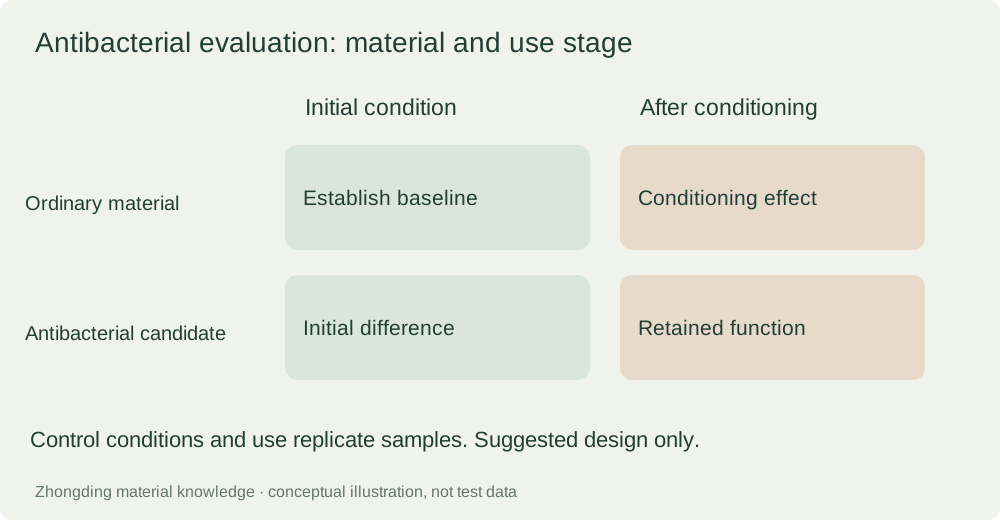
Daily-use silicone products experience wetting, washing, drying and friction. A useful project comparison distinguishes untreated and functional materials, both before and after an agreed use-conditioning procedure. Define the detergent, temperature, actions and number of cycles beforehand rather than selecting conditions after seeing the results.
| Comparison group | Question addressed |
|---|---|
| Ordinary formulation, initial condition | What is the baseline without treatment? |
| Antibacterial candidate, initial condition | Does the proposed change produce the intended difference? |
| Ordinary formulation, after conditioning | What does conditioning itself change? |
| Antibacterial candidate, after the same conditioning | Are the function and product characteristics retained? |
This is a suggested experimental structure, not a universal mandatory protocol. Alongside microbiological assessment, inspect residue retention, defects at bristle roots, colour and surface condition. Functional and physical durability both belong in the decision.
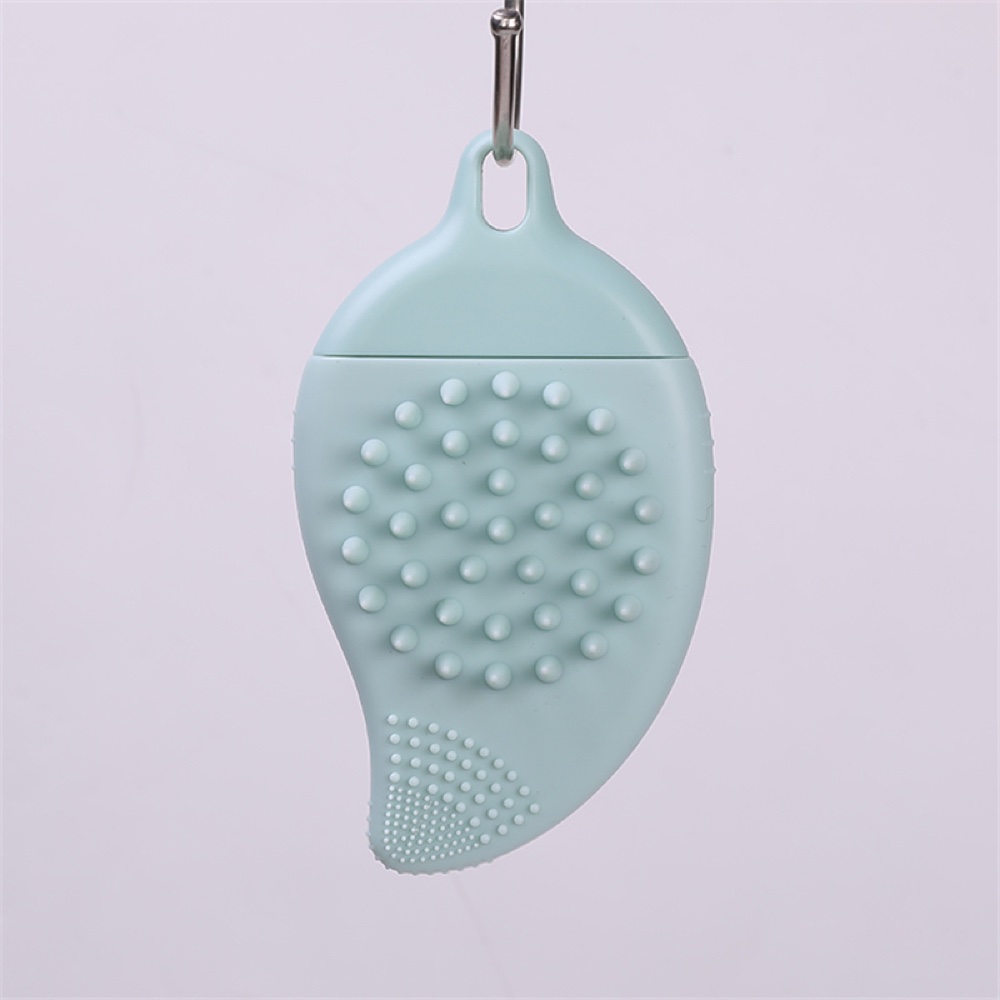
Existing Zhongding cleaning brush: a geometry example, not a claimed antibacterial product.
Illustrative scenario: a customer wants a more hygienic brush
This is a hypothetical requirements exercise, not a completed Zhongding antibacterial project.
Use Zhongding’s existing mango-shaped and hand-loop silicone brushes as starting points for a geometry discussion. Split the request into easier residue removal and evaluation of an antibacterial material under agreed conditions. First inspect spacing, root grooves and hanging arrangements. Then discuss the feasibility of antibacterial treatment with the material supplier.
If residue is trapped by the geometry, address that issue before comparing formulations. A laboratory surface result does not remove trapped soil for the user. Where a clear antibacterial requirement remains, evaluate the chosen finished product initially and after cleaning, together with requirements appropriate to its intended contact use.
The proposed output is evidence for a decision: what improved, whether improvement persisted and whether normal cleaning and handling were affected. A successful outcome should only be stated after the work has actually been completed.
Relate claims to the intended market and use
In the United States, EPA distinguishes treatments intended solely to preserve the article from claims involving public-health protection. Protection of the material itself should not be presented as protection of the user against disease. This is a US regulatory distinction, not a complete rule for every destination market. US EPA: consumer products treated with pesticides
Zhongding’s team has years of silicone product manufacturing experience. Existing brush designs provide a basis for discussing product requirements, samples and manufacturing conditions. An antibacterial version would need project-specific assessment; an ordinary brush should not simply be renamed an antibacterial product.
For a custom silicone product enquiry, describe the intended setting, destination market, cleaning method and practical hygiene problem. A useful product aligns everyday maintenance, material function and the evidence used to describe it.