
First identify what was tested
A report describing a “silicone sheet” can provide information about that specimen, but its relationship to an assembled straw cup still needs to be established. Check the sample photograph, model, colour, material version, submission date and tested components. Determine whether it represents the final article or whether there is an adequate basis for extending its findings.
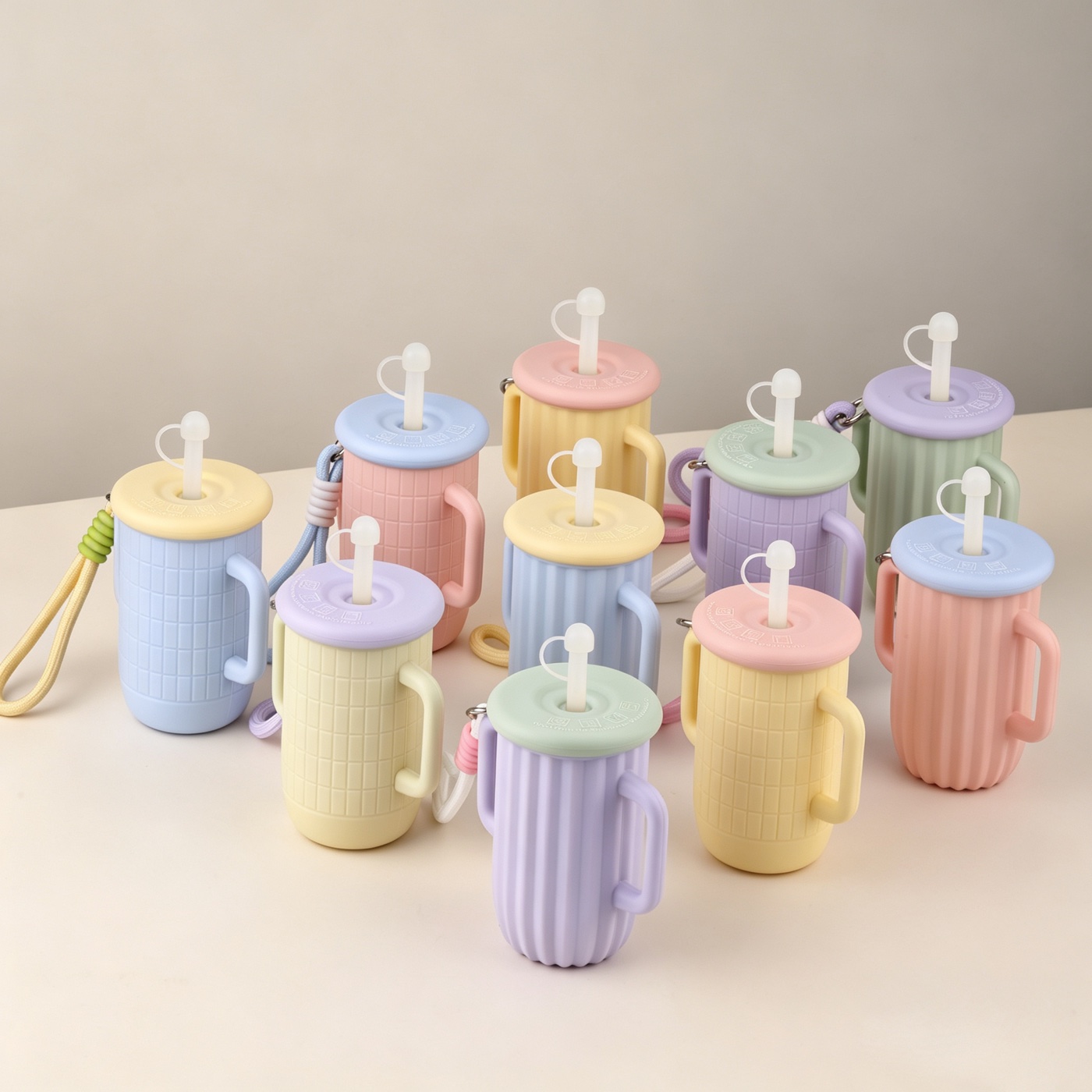
Zhongding’s single-handle straw cup, ribbed double-handle cup and column-textured double-handle cup can share visual themes without sharing one sample identity. Replacing a lid or straw may change the contact material. Changing the body can change contact area and fill quantity. “Made by the same factory” is not, by itself, a reason for a report to cover those differences.
This does not mean every colour or modification mechanically requires an identical full test programme. The practical approach is to list changes, ask the responsible laboratory or compliance specialist to determine representativeness and necessary supplementary work, and retain the reasoning with the documentation.
Compare conditions before comparing numbers
Food simulant, temperature, duration, contact area and repeated-use arrangements define the question a test answers. Different results can reflect material differences, different test conditions, or both. Ranking products by numbers taken out of context can turn incomparable results into a misleading quality league table.
For rubber articles within its scope intended for repeated contact with aqueous foods, current 21 CFR 177.2600(e) specifies extraction of the finished food-contact surface with distilled water at reflux temperature. Total extractives must not exceed 20 mg/in² during the first seven hours, or 1 mg/in² during the following two hours. These are separate requirements for separate periods. Quoting only the smaller second-stage value is incomplete, and it cannot be directly compared with a value in mg/dm² from a different Chinese test. Composition, scope and other applicable provisions still matter. The section is not an FDA-issued certificate for a particular finished cup. eCFR: 21 CFR 177.2600
This example illustrates how to read a report: establish the applicable rule, understand the procedure, then interpret the result. It does not state that Zhongding’s cup styles have undergone these tests or that every destination market uses the US conditions.
Contact area, fill quantity and units can change the interpretation
Table 2 of China’s GB 4806.16—2025 requires overall-migration results for silicone rubber food-contact articles specifically intended for infants and young children to be converted using the actual area-to-volume relationship in use, with a limit of 60 mg/kg. Intended users and the applicable contact geometry are therefore relevant to assessment. GB 4806.16—2025, Table 2 footnote
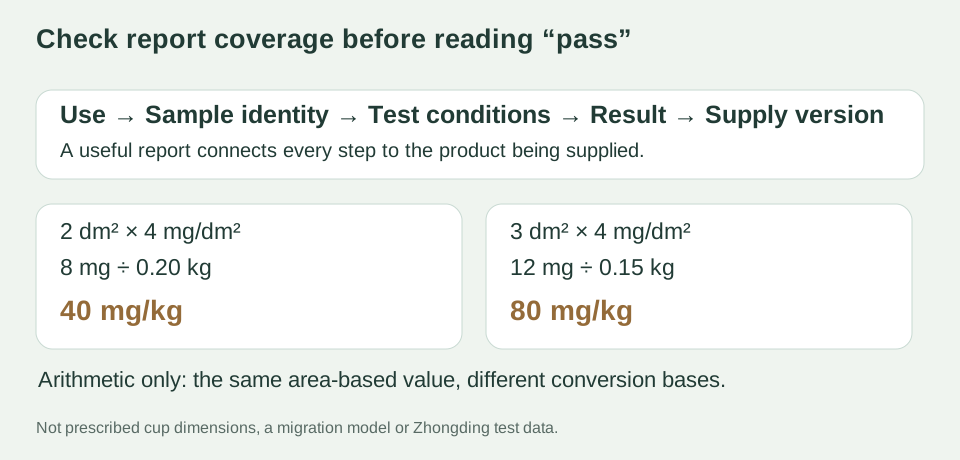
A purely arithmetic illustration explains why the basis matters. Assume a measured area-based result of 4 mg/dm² and otherwise comparable testing, then convert using the stated contact areas and food masses:
| Hypothetical conditions | Amount associated with the area | Result divided by food mass |
|---|---|---|
| 2 dm² contact area and 0.20 kg food | 4×2 = 8 mg | 8÷0.20 = 40 mg/kg |
| 3 dm² contact area and 0.15 kg food | 4×3 = 12 mg | 12÷0.15 = 80 mg/kg |
These figures are not standard-prescribed cup geometries, Zhongding measurements or an experimental model predicting real migration. They only illustrate that the same area-based result produces different converted values when the conversion basis changes. Formal assessment must use the applicable rules for contact area, volume or mass, filling and calculation; a favourable basis cannot simply be chosen.
Two handles do not automatically establish a user age group. Whether a product is marketed specifically for infants or young children must be addressed through its positioning, actual design, labelling and applicable requirements, not inferred from a photograph’s appearance.
Keep the evidence connected to subsequent supply
A report describes the specified sample and test scope under the stated conditions. Production material versions, colours, processes and component changes need corresponding control. An old report does not automatically describe every later alteration.
Articles 5–7 of EU good manufacturing practice Regulation (EC) No 2023/2006 address quality assurance, quality control and documentation. For a purchaser, the relevant question is how production remains consistent with the agreed design, rather than whether a document can be collected once before ordering. Regulation (EC) No 2023/2006 on good manufacturing practice
A useful change record can be specific: which component changed, whether a food-contact surface is involved, whether material or colour changed, which assessment remains applicable, and what further work is required. Its purpose is to ensure that engineering, procurement, quality and sales are referring to the same product configuration.
Turn an unclear request into a development brief
When choosing a silicone cup manufacturer, start with the market, intended users, drink types, temperature and contact duration, along with a preferred style. Discuss the lid, straw, colours, markings, packaging and cleaning method, then agree on the required evidence. This is more actionable than asking only whether “LFGB can be done.”
Zhongding’s team has years of silicone product manufacturing experience. Using existing single-handle and double-handle cup styles as starting points, we can discuss custom requirements and translate an appearance concept into material, structure, component and sample-review items. The coverage of available reports and documents is checked for the particular project; a raw-material document is not presented as finished-product proof for every cup.
A well-defined custom silicone cup project should leave both parties able to answer the same questions: which cup does this conclusion cover, how may it be used, and how will the agreed configuration be maintained? Clear answers make purchasing and delivery decisions better grounded.