
Give deformation a specific job
Flexibility can support a comfortable rim, ice release, bending bristles or compression at a sealing feature. These functions require different forms of deformation. A mould may need to turn locally inside out, while a drinking cup needs to retain useful volume and rim fit during ordinary handling. A brush needs its bristles to recover after pressure is removed.
An easy-release silicone ice mould is therefore not a model for every aspect of cup performance. Nor should a brush’s flexibility be transferred directly to a cup wall. A versatile material can be designed for different applications; this does not mean one finished product is suitable for every application.
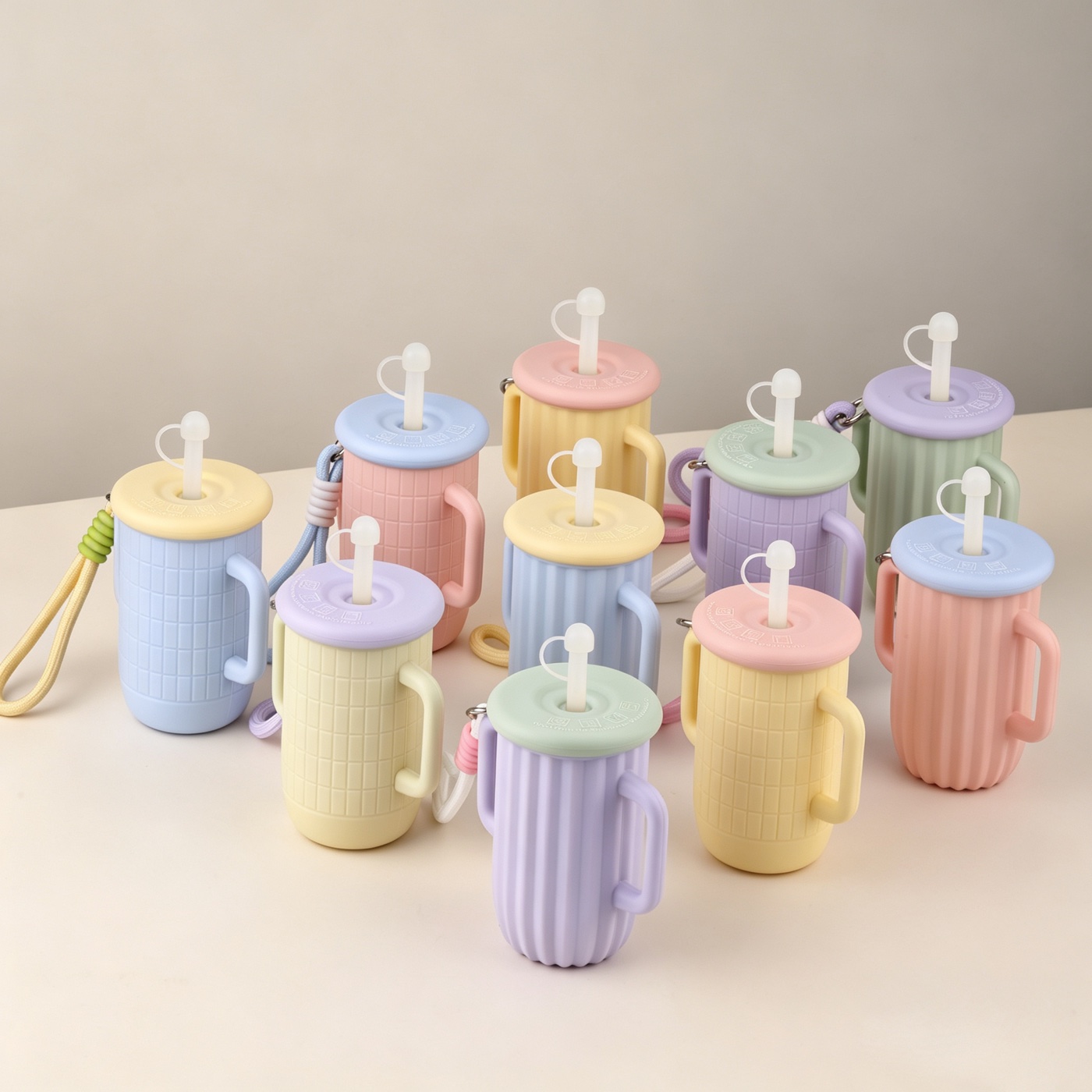
Zhongding’s single-handle silicone straw cup, ribbed double-handle cup and column-textured double-handle cup illustrate that distinction within one product family. They offer different grip positions, surface textures and accessory combinations. After choosing a style, a project still needs to define its use: table use, short outings or another separately validated purpose. An attractive image cannot answer all those questions.
Brief contact and all-day storage are different conditions
Time is easy to overlook with a drinking cup. Filling and emptying it promptly and leaving a drink inside for much longer are both casually described as “holding a drink.” A food-contact assessment needs a more precise description.
Table 3 of China’s GB 4806.16—2025 provides the following overall-migration test conditions for silicone rubber articles with intended contact temperatures no higher than 40°C and contact durations no longer than 24 hours. This table concerns selection of laboratory conditions. It is not advice on beverage storage or a temperature rating for Zhongding’s existing cups.
| Intended contact time, always at ≤40°C | Test temperature and duration in Table 3 |
|---|---|
| Up to 10 minutes | 40°C for 10 minutes |
| More than 10 and up to 30 minutes | 40°C for 30 minutes |
| More than 30 minutes and up to 2 hours | 40°C for 2 hours |
| More than 2 and up to 24 hours | 40°C for 24 hours |
These differences demonstrate why validation must cover the advertised application. Evidence for brief contact does not automatically establish suitability for extended storage. Uses outside the table’s temperature or duration boundaries must not simply be assigned to it. GB 4806.16—2025, Section 5.1 and Table 3
Heat resistance, boiling and dishwasher suitability are different questions
A material’s heat resistance describes possibilities at material level. Whether an assembled cup can be boiled, microwaved or washed in a dishwasher depends on the finished article and the specified procedure. The lid, straw, markings and other accessories may all affect the answer.
Dishwasher exposure also includes detergent, spraying, support during washing and drying conditions. It is not merely a temperature. A component that looks unchanged after brief hot-water contact has not thereby demonstrated that repeated cleaning leaves the complete cup’s shape, fit and intended function unaffected.
In its original consumer notice of 11 February 2026, China’s State Administration for Market Regulation specifically advised buyers to check microwave and boiling conditions for plastic and silicone tableware, clean new items thoroughly and follow labelled temperature and use limits. It did not prescribe a universal boiling time for every silicone cup. SAMR: food-contact product consumer advice
Treat cleaning access as a product feature
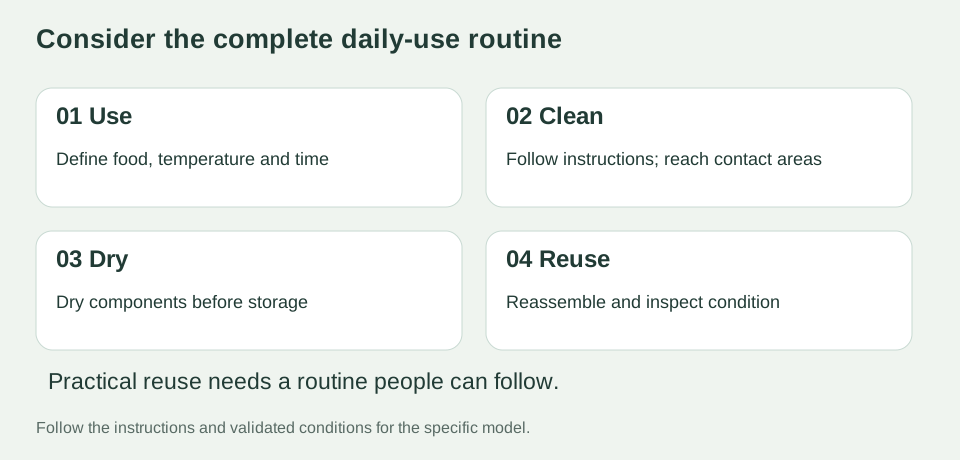
The experience of a straw cup extends beyond drinking. A user must identify how the lid comes apart, clean the straw’s inner surface, reach connections and reassemble the pieces. An attractive design does not compensate for a routine that is unnecessarily difficult.
For a ribbed double-handle silicone cup, sample review can examine whether the texture is easy to wipe and the handle roots are accessible. For a single-handle straw cup, it can focus on the straw-to-lid connection and whether the carry-cord attachment interferes with normal handling. These are proposed design checks, not claims that the current styles have completed a particular cleanability test.
Removable components should be taken apart, cleaned, dried and reassembled according to their instructions. A permanent joint should not be pulled apart as a substitute for cleaning. Excessive stretching may damage a feature and affect both its appearance and fit. “Easy to put back together” belongs alongside “possible to reach with a brush” in the development brief.
Reuse depends on wanting to use the product again
A reusable cup can quickly become unused if accessories are easily lost, cleaning is awkward or instructions are unclear. Useful durability therefore includes accessory compatibility, an achievable cleaning routine and understandable use conditions, as well as the condition of the material itself.
Brands can turn this into model-specific instructions: identify removable parts, suitable cleaning procedures, uses that have not been established, and damage or abnormal conditions that require the user to stop using the item. A broad claim that silicone is durable does not replace this information. Nor is an invented universal replacement interval helpful.
Zhongding’s team has years of silicone product manufacturing experience. Around our existing silicone cups, we can discuss body styles, accessories, texture and packaging instructions, bringing handling, cleaning and repeated assembly into sample review. We also offer everyday silicone directions such as popsicle and ice moulds, with intended uses and requirements assessed separately. For a customer, this turns a broad idea for a silicone product into a clearer task: make something people want to use regularly and can use correctly each time.