
Heat resistance and flame retardancy answer different questions
Heat resistance concerns whether a material retains required properties after thermal exposure. Flame retardancy concerns behaviour under specified ignition conditions, including continued burning and relevant flaming drips. One considers service performance after heat; the other considers behaviour in a defined burning test.
A silicone pad near a heat source may need to retain its shape through repeated thermal cycles. An internal appliance component may also have a flammability requirement arising from the appliance design. Both should appear in the design brief. A high temperature rating does not establish the required burning classification.
UL Solutions describes its UL 94 vertical method as evaluating burning, afterglow and dripping. Its 50 W, 20 mm vertical flame method serves the V-0, V-1 and V-2 classifications; the 5V method uses a 500 W, 125 mm flame. These are different methods, not simply different labels attached to one identical test. UL Solutions: combustion tests for plastics
What does a flame-retardant formulation change?
Under strong heating or flame exposure, a material may decompose and produce substances that participate in combustion. A formulation can target heat input, decomposition behaviour or surface protection. Ingredients may help through heat absorption, barrier formation or interacting mechanisms, depending on the particular system.
A 2023 original study in Coatings investigated magnesium hydroxide combined with phosphorus-containing ingredients in silicone rubber. The authors discussed heat absorption and a surface covering that impedes heat and oxygen transfer, while also identifying dispersion and compatibility as processing and mechanical concerns. Its coating formulation is not a ready-made recipe for molded consumer products. 2023 study of a flame-retardant silicone composite system
The practical lesson is to assess the entire formulation. Does it disperse consistently, fill thin sections, cure reliably and retain adequate assembly performance? A functional improvement has to be achievable in the manufactured component.
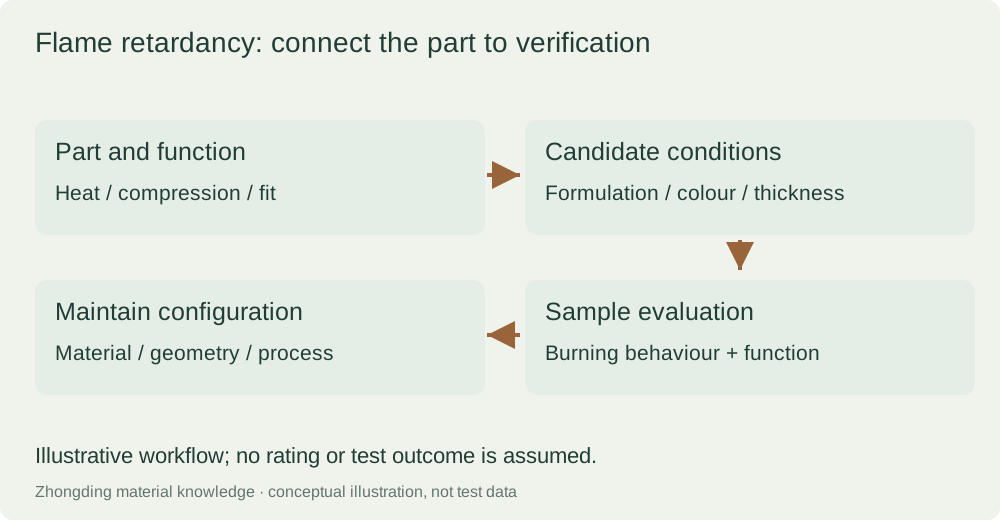
Why does a change in thickness matter?
Thickness affects the specimen’s thermal response during flame exposure and defines the local geometry of the real part. A rating obtained at a greater thickness should not be assigned automatically to a thinner component. Read thickness and colour conditions together with the classification.
WACKER’s August 2025 selection guide lists ELASTOSIL LR 3170/40 as V-0 at 3 mm and HB at 0.5 and 0.8 mm, with black V0 noted in its characteristics. This is supplier information for a specific grade, not a Zhongding report or a universal silicone thickness requirement. WACKER product selection guide, liquid silicone rubber table
A design may contain a thick body but thin connecting ribs, lips or local reductions. Identify those areas for engineering and laboratory review. The material information supplies a selection basis; the drawing establishes how that material is actually used.
Set colour, flexibility and assembly requirements early
Information for a black formulation should not be extended to another colour without evaluation. UL’s plastics recognition material identifies thickness recognition and colours to be tested as relevant topics. Defining colour early makes it easier to maintain a consistent development configuration. UL Solutions: plastics recognition programme topics
A flame-retardant silicone component is not necessarily better when made harder. A part fitted into a groove can be damaged by excessive assembly effort. A clamped part also needs its compressed function considered. Where silicone combines with metal or plastic, attachment and contact regions deserve attention alongside burning behaviour.
It helps to maintain two parallel sets of acceptance criteria. One covers the required burning assessment and specimen conditions. The other covers the product’s function: installation, sealing or cushioning, and continued operation after relevant thermal exposure. A suitable solution addresses both.
Illustrative scenario: an appliance cushioning component
The following is a hypothetical engineering exercise. It does not identify a historical Zhongding customer and contains no assumed successful test outcome.
Suppose a customer needs an internal silicone cushioning component for an ordinary appliance, with a defined flammability requirement and straightforward assembly. First establish location, proximity to heat, normal operating temperature, minimum thickness, colour and compression. The appliance requirements then determine the necessary assessment.
Retain the original geometry as a reference while comparing appropriate candidate flame-retardant materials. If thin edges repeatedly show damage, examine filling, demolding and edge geometry before attributing everything to insufficient material strength. If a thicker section helps durability during assembly, check available space, compression and interaction with adjacent parts as well.
During sampling, keep the selected formulation, colour, dimensions and process conditions traceable to one another. Once testing is complete, production needs to maintain that confirmed configuration. A material substitution or important geometry change calls for an assessment of its consequences.
This approach aims at a reproducible product configuration, rather than a favourable result from an isolated sample.
Starting a flame-retardant silicone project with Zhongding
Zhongding has previously made flame-retardant silicone for customers and can discuss new customization requirements. Useful inputs include a part drawing, installation context, colour, flexibility and target test requirements. Where the specification is incomplete, begin with the operating environment and the problem to resolve.
For silicone OEM/ODM development, translate the desired outcome into clear material and component conditions. Zhongding’s manufacturing experience can support discussions around geometry and samples; the particular rating and acceptance requirements are defined within the project. A useful flame-retardant part meets the relevant burning requirements while continuing to perform its original job.