
Zhongding's existing mango-shaped brush and wearable palm brushes provide useful examples. Textured areas, fine bristles, hanging openings and palm straps serve different purposes. Separating those purposes makes a custom silicone cleaning brush brief more useful than asking only for a softer or denser brush.
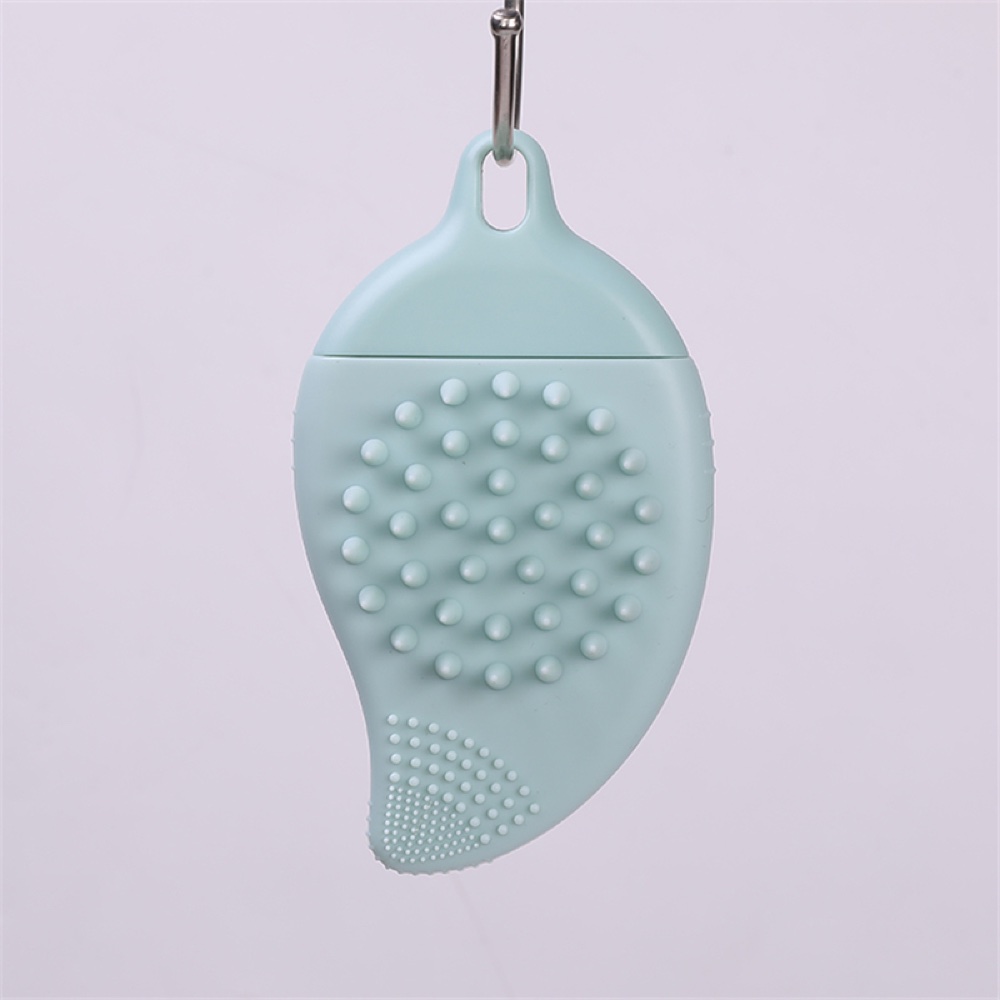
Existing textured brush body with a hanging opening. Intended contact surfaces and performance require project-specific confirmation; this article does not present a cleaning brush as a treatment product.
Material hardness is not whole-brush feel
A hardness test measures material response under specified indentation conditions. Bristles often work primarily by bending. The same material formed into a short, thick projection and a long, slender bristle will not respond identically. Describe material softness and ease of bristle bending separately.
Carol Livermore's 2007 MIT OpenCourseWare lecture gives ideal cantilever tip stiffness as k = 3EI/L³. With material, cross-section and boundary conditions unchanged, doubling length reduces theoretical stiffness to 1/8, within small-deflection linear-elastic assumptions. The comparison shows that geometry matters; it is not a prediction of actual silicone-brush feel. MIT original lecture 7, page 22
Real bristles may taper, bend substantially, touch their neighbors and move with a flexible base. Silicone may also depart from the simplified model. Use the equation to understand direction, then assess the actual geometry and contact conditions.
Why greater density is not a complete specification
Closer spacing changes the number of bristles in contact, their interaction as they bend, fluid passage and the cleaning path between them. An easily bent individual bristle does not necessarily produce an equally compliant brush field under compression.
The action matters too. Pressing vertically, sliding back and forth and brushing along an edge impose different demands. A smooth surface and a grooved object cannot be evaluated by an identical subjective impression. Adding bristles without defining the cleaning target and movement leaves the improvement undefined.
| Feature | Experience to examine | Useful comparison |
|---|---|---|
| Bristle length and thickness | Initial contact, bending and recovery | Keep material and layout constant while comparing geometry |
| Spacing and zones | Collective contact, fluid passage and local access | Use the same contact surface and action |
| Roots and base thickness | Combined bristle and body deformation | Record bristle bending separately from base bending |
| Tip shape and visible defects | Contact consistency and scratchy feel | Examine tips, flash and obvious damage |
| Grip and palm strap | Hand position and control | Compare dry and wet handling with intended hand sizes |
These are structural assessment directions, not evidence of cleaning percentages, antibacterial activity or skin benefits.
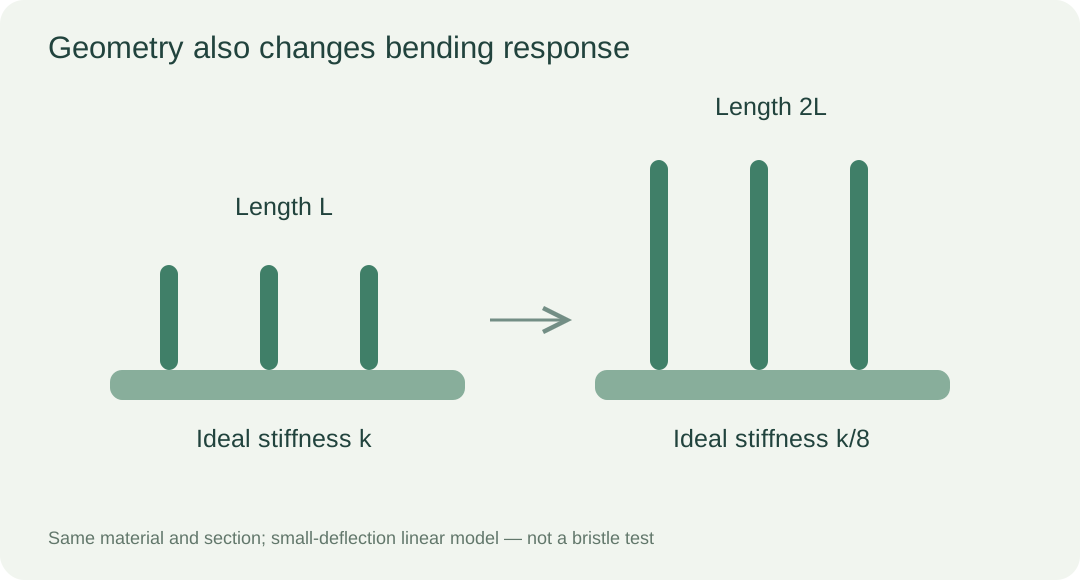
The 1/8 relationship belongs to an ideal small-deflection model, not a measured product result.
What the mango and palm-strap formats illustrate
The mango brush's outline, textured zone and hanging opening support discussion of grip direction, local contact and storage after washing. A hanging opening provides a storage point; it does not establish a drying time or antibacterial effect.
The wearable palm brush puts hand positioning at the center of the design. Its strap helps locate the hand relative to the body, but suitability depends on hand size, fit, wet handling and removal. Brush-face design and grip should be evaluated together. A suitable brush surface offers limited value if the grip forces an awkward contact angle.
For personal-care applications, define the body area and ordinary cleansing purpose first. A soft feel does not demonstrate suitability for every sensitive-skin user or establish treatment, acne or other unverified effects. Claims should follow evidence for the intended use.
Compare observations rather than vague preference
Specify the same cleaning object, wetting condition, medium and action. Ask evaluators to describe observable behavior: an edge is difficult to reach, the entire bristle field folds during a forward stroke, or the hand shifts when wet. Such descriptions translate into design changes more readily than a single softness score.
When comparing geometry, keep material and base design as consistent as possible. When comparing materials, retain the geometry. Identify each sample rather than relying on color or memory. Separating variables makes the reason for an improvement easier to understand.
Evaluate cleaning and drying separately. Does residue collect at the roots? Can the brush field be rinsed effectively? Does the intended storage position retain water? Washing and environmental conditions affect results, so avoid promising a fixed drying time without evidence. Cleaning-efficiency, antibacterial or special-care claims need their own appropriate evaluations; handling trials do not establish them.
How Zhongding can support brush development
The mango and palm-strap formats in Zhongding's cleaning and applicator product range are starting points for discussing body shape, texture, grip, color and packaging. We can review custom silicone cleaning brushes against the actual cleaning target and action, then coordinate sample confirmation and production evaluation.
Our team has years of silicone product manufacturing experience. The practical objective is to turn an unsatisfactory feel into a defined question: material response, bristle geometry, base support or a grip-related change in loading. Sharing the intended contact object, an existing sample and the action that feels wrong gives the next revision a clear purpose.
The silicone hardness selection guide provides further context on hardness and product behavior. A useful brush results from matching material, geometry and handling conditions, rather than maximizing or minimizing one parameter.