
Zhongding's single-handle straw cup, ribbed double-handle cup and column-textured double-handle cup illustrate these differences. Their handles, surface textures, lids, straws and carry accessories provide practical starting points for custom silicone cups.
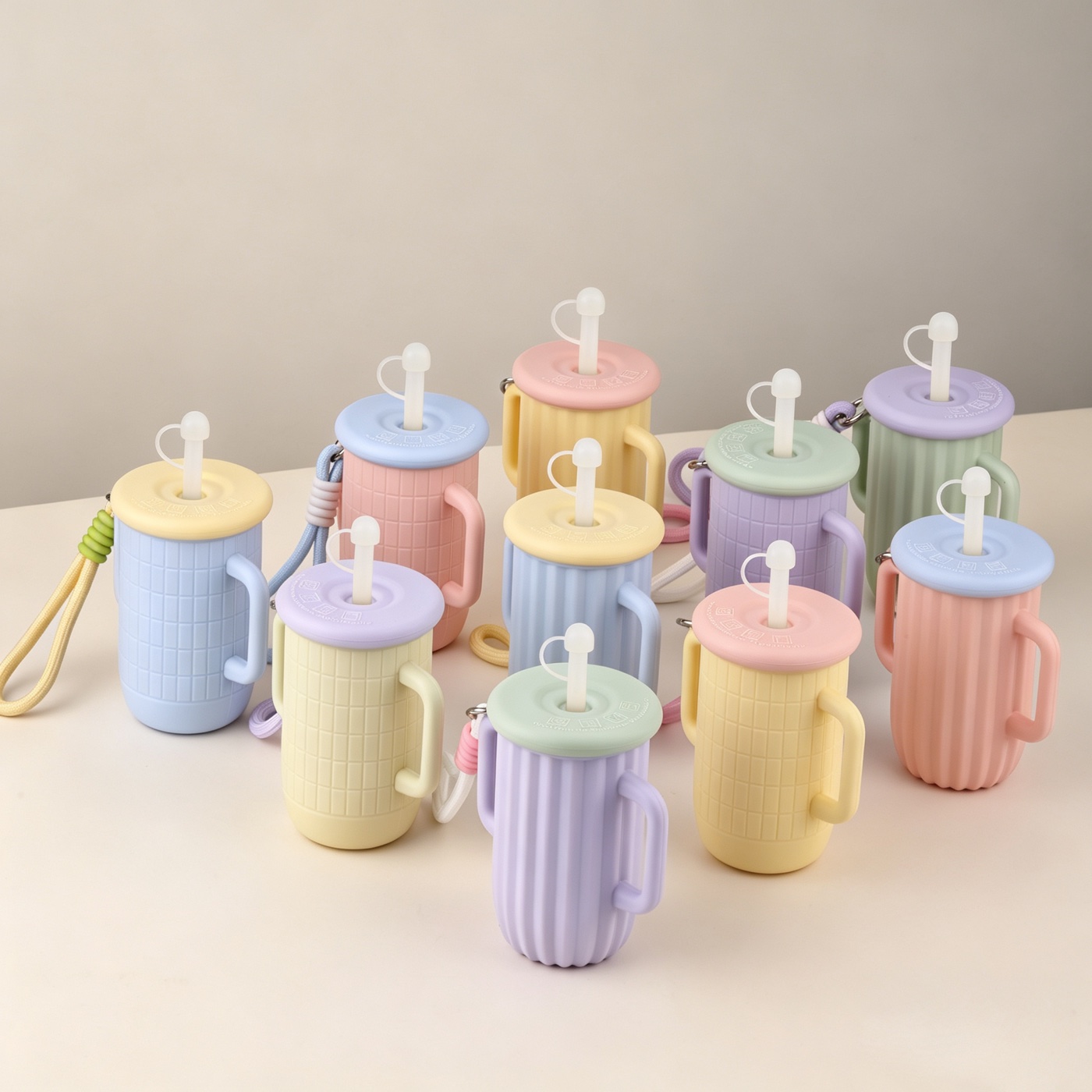
Existing single- and double-handle formats with textured bodies and straw lids. The image does not establish a leakproof rating, age suitability or heat performance.
Handles locate the grip, but the body still deforms
Without handles, a user may grip the wall directly. With handles, force travels through their roots into the body. Two handles provide two grip positions, but users may still lift one side or ignore the handles and squeeze the wall.
Handle size and location therefore need assessment together with the cup. An easy-to-grasp handle may distort the rim under load, affecting lid fit. A wall that compresses readily can push liquid toward a straw or another opening. Follow the entire lift, move, drink and set-down sequence, rather than judging only an empty cup held still.
Compare lifting a double-handle cup by both handles and by one. Where a carry cord is present, confirm its intended use; a carrying accessory is not automatically a guarantee of capacity under arbitrary loading.
Stability depends on the support area and center of gravity
OpenStax's 2022 College Physics 2e, section 9.3, describes the relationship between the center of gravity and the support boundary. Once the vertical line through the center of gravity passes outside that boundary, gravity can promote further tipping. Original textbook: Stability
For a rigid body tilted slowly without sliding, the illustrative relation is tanθ = r/h: r is the effective support half-width in the tipping direction, h the center-of-gravity height and θ the critical angle. If a hypothetical r/h rises from 0.5 to 1, the theoretical angle rises from about 26.6° to 45°. These are geometric examples, not measured Zhongding cup angles.
A real cup adds liquid motion, base deformation, surface slope and sliding. The model is not an acceptance limit. Its practical lesson is that a wide rim does not establish a wide supporting base, and changing the fill requires another look at both static and moving behavior.
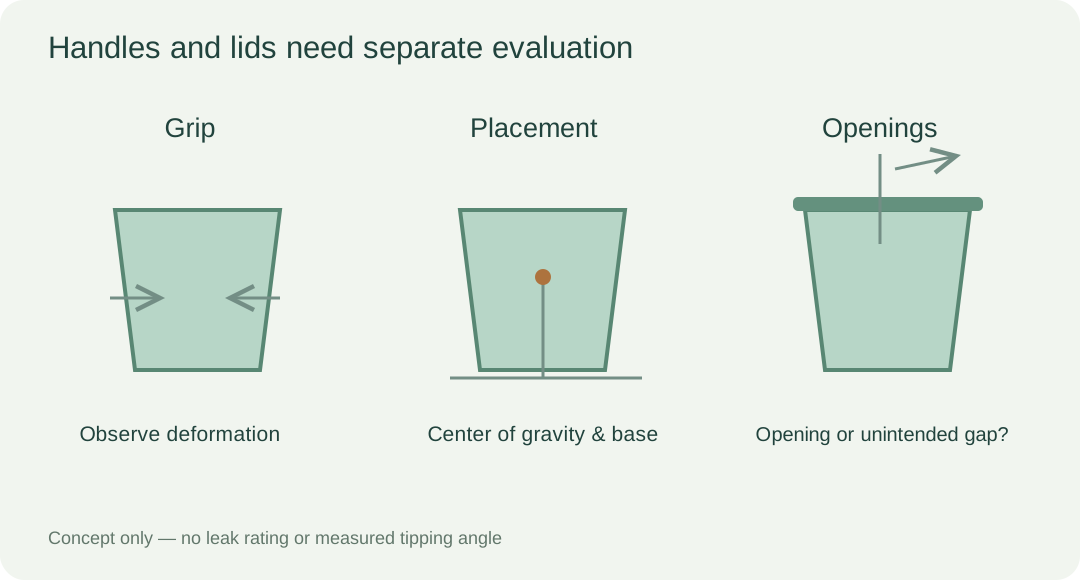
Grip, tabletop stability and opening flow should be observed separately. The center-of-gravity sketch illustrates a static principle only.
A closed lid can still contain an open liquid path
The lid-to-rim interface, straw opening and any other actual openings serve different functions. A hole that allows convenient straw insertion does not necessarily close the liquid path. Without confirmed design and evaluation conditions, “with lid” should not become “leakproof when inverted.”
First identify whether liquid leaves an intended opening or escapes through a joint that should remain closed. Then identify the trigger: tilting, wall compression, handle lifting or lid reassembly. This helps distinguish an open flow path from a seating problem or deformation.
Making a lid tighter is not a complete solution. Excessive assembly effort can lead to partial seating that looks closed from above. Closure should be easy to recognize and should be evaluated under actual handling actions.
Design for cleaning and correct reassembly
Follow the cleaning path around the straw, lid edge and handle roots. Removable parts need understandable disassembly and reassembly. A component that comes off easily but is hard to orient correctly can create a new problem after washing. Parts not designed for removal should not require forceful pulling as a routine cleaning method.
A useful sample record can cover:
- Handling and placement both empty and at the intended fill.
- Rim deformation when using one handle, both handles or the wall.
- Whether complete lid seating is visible and understandable.
- Liquid paths under agreed positions and actions, separating normal openings from unintended gaps.
- The same observations after cleaning, drying and reassembly.
This is a use-based evaluation framework, not a national standard or a substitute for applicable market requirements.
Include the actual accessories in food-contact documentation
A cup can contain a body, lid, straw, cord and other components. Do not assume identical materials throughout. Identify which parts contact the drink and which serve only as carrying accessories, then confirm materials and use conditions.
The framework in Article 3 of Regulation (EC) No 1935/2004 is based on normal or foreseeable use. Cold-drink, hot-drink or cleaning claims therefore need evidence relevant to the finished item and the stated conditions. The word silicone alone cannot establish them. EUR-Lex consolidated text dated 27 March 2021
Start with an existing cup and a specific action to improve
Zhongding's team has years of silicone product manufacturing experience. Our existing silicone cup range supports discussion of single or double handles, textures, accessory combinations, colors and packaging, followed by sample confirmation for the intended use.
If a project aims to reduce unintended spilling, difficult gripping or confusing reassembly, describe the intended user, drink, fill, carrying method and exact inconvenience. We can use that brief to discuss how the body, handles and accessories work together. Public claims about leakage, age suitability, temperature and cleaning should follow the confirmed documentation for the particular product.
A useful cup gives each action an appropriate structure and evaluation. Adding more handles, lids or texture is not a substitute for that work.