
A formulation is an interconnected system
For the consumer products discussed here, “silicone” primarily means silicone rubber. Its polymer, fillers, crosslinking system and other ingredients work together. The polymer supplies the underlying structure; fillers can reinforce the material or contribute functions; crosslinking creates an elastic network. WACKER describes these constituents in its October 2025 material and processing guide. WACKER material and processing guide
Changing one aspect of that system can affect processing, deformation or surface behaviour. Asking whether an antibacterial ingredient can be added, or whether a flame-retardant formulation is available, opens the discussion. The product still has to perform its original task after that change.
Consider a cleaning brush. Its basic job is to make useful contact with a surface. A promising laboratory material is not enough if fine bristles cannot be molded consistently, defects appear at their roots, or the grip becomes uncomfortable. The material, mold and product geometry need to be considered together.
Equal hardness does not establish equal durability
Hardness is convenient to discuss, but it answers only part of the design question. A request for “60 Shore A” describes an intended indentation hardness, not tear resistance, repeated bending performance or behaviour after sustained compression.
WACKER’s August 2025 selection guide illustrates this with two solid silicone rubber grades:
| Grade | Shore A hardness | Tear strength, ASTM D624 B |
|---|---|---|
| ELASTOSIL R 401/60 S | 60 | 24 N/mm |
| ELASTOSIL R 420/60 S | 60 | 44 N/mm |
These are supplier typical values, not Zhongding test results or procurement specifications. Equal hardness accompanies different tear values; the table does not establish which individual ingredient caused the difference. WACKER product selection guide, solid silicone rubber table
For Zhongding’s existing silicone cleaning brushes, this makes the bristle roots and hand-loop connections useful areas to examine. For a cup, grip deformation and handle attachment loads are separate questions. Both involve material flexibility, but they need different observations.
Match the functional direction to the environment
“Functional silicone” is best treated as a group of possible design directions rather than a single superior grade.
| Requirement | Question to resolve | Other properties to retain |
|---|---|---|
| Antibacterial or mould resistance | Which organism and contact conditions matter? | Performance after cleaning, surface condition and intended contact use |
| Flame retardancy | Which burning assessment, thickness and colour apply? | Strength, assembly, heat ageing and manufacturing consistency |
| Heat or steam resistance | Hot air, hot water or steam, and for how long? | Elasticity, dimensions and the original product function |
| Liquid resistance | Which liquid, concentration and temperature? | Swelling, mass changes and mechanical behaviour |
| Heat conduction or insulation | Should heat be removed or its transfer reduced? | Thickness, contact, electrical requirements and support |
| Antistatic or weathering performance | Charge accumulation or outdoor exposure? | Colour, surface condition and function after ageing |
This is a requirements framework, not a list of verified capabilities for every Zhongding product. Shin-Etsu’s supplier catalogue separately identifies steam-resistant, antistatic, flame-retardant and thermally conductive grades, illustrating the need for application-specific choices. Shin-Etsu rubber compound catalogue
Define the failure before choosing the feature
Suppose a customer wants a daily-use silicone product to be “more durable.” Does it deform after washing, tear during stretching, soften after liquid contact or retain residue on its surface? Each problem points towards a different investigation.
A useful brief states where the product operates, what it contacts, which actions it experiences, and what must remain acceptable after repeated use. Those details allow the material supplier, product manufacturer and laboratory to work towards the same outcome.
For thermal exposure, ISO 188:2023 provides accelerated ageing and heat-resistance test methods for vulcanized or thermoplastic rubbers. Selecting a method still requires a clear decision about which changes matter to the product; the standard title alone does not establish service life. ISO 188:2023 official description
Illustrative scenario: material problem or geometry problem?
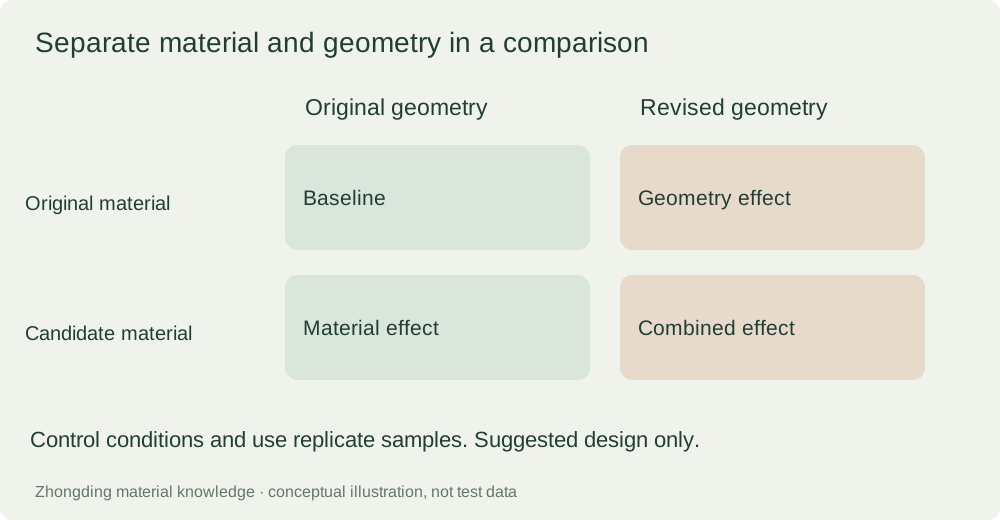
A customer wants a hand-loop silicone cleaning brush that is easy to put on and withstands repeated stretching. Compare two material candidates and two connection geometries, giving four combinations: original material with original geometry, candidate material with original geometry, original material with revised geometry, and candidate material with revised geometry. Keep the action, environment and molding conditions controlled where possible, with replicate samples in each group.
If the material-only change helps, investigate that direction further. If changing a radius or local thickness helps, examine stress concentration. If only the combined change helps, the interaction deserves attention. A single sample cannot establish a reliable result, but this comparison is more informative than changing everything at once.
Also record fitting effort, cleaning contact and molding consistency. Avoid optimizing resistance to one failure while making the product harder to use.
Working with Zhongding on a functional requirement
Zhongding’s team has years of silicone product manufacturing experience, with existing cups, kitchen products, travel bottles and cleaning brushes. Zhongding has also made flame-retardant silicone for customers and accepts related customization enquiries. Development discussions can start from an existing style or a new use scenario.
Provide a drawing or reference product, operating conditions, the principal problem, appearance requirements and destination market. These inputs support a discussion of material screening and sample evaluation; specific functional ratings should be defined and verified within the project.
A useful custom silicone product brief explains why a material direction was selected, which problem it addresses, how samples will demonstrate improvement and which conditions must remain controlled in production. That gives buyers more useful information than a collection of feature labels.