
Licking, slow feeding and making treats are different tasks
Lick mats hold spreadable food. Slow-feeding bowls change access through paths and obstacles. Treat moulds portion and shape food, which is then released before being offered. These products may form a set, but sharing a food-related purpose does not make their design requirements identical.
Easy release is useful in a mould, but it cannot establish that its contents suit every dog or cat. Ingredients, portions, released shape, hardness and feeding behaviour still matter. Adding a paw motif to a human ice tray does not automatically make it an appropriate pet product.
Zhongding’s existing silicone popsicle and ice moulds provide a structural starting point for discussing compartments, filling and release. A pet treat mould project should reconsider the food units and instructions for its intended animals instead of simply copying human ice-cube dimensions.
Why willingness matters more than compulsory effort
In an original study by UC Davis researchers Delgado, Han and Bain, 17 neutered indoor cats received a food puzzle and a tray across ten 30-minute trials. Overall, they ate more from the tray. The paper appeared online in 2021 and in the 2022 volume of Animal Cognition. Original study: cats choosing freely available food or effortful access
The study did not test silicone lick mats and does not represent every cat or dog. Its design implication is to offer an achievable task instead of assuming that greater difficulty necessarily adds enjoyment.
Walking away could reflect deep textures, food preference, location or unfamiliarity. Duration alone cannot distinguish steady feeding from repeated failure. Observe voluntary approach, successful food retrieval, the start of edge chewing and where food remains.
Design concept: time is one observation; task completion and changing behaviour also matter.
Texture should create accessible paths
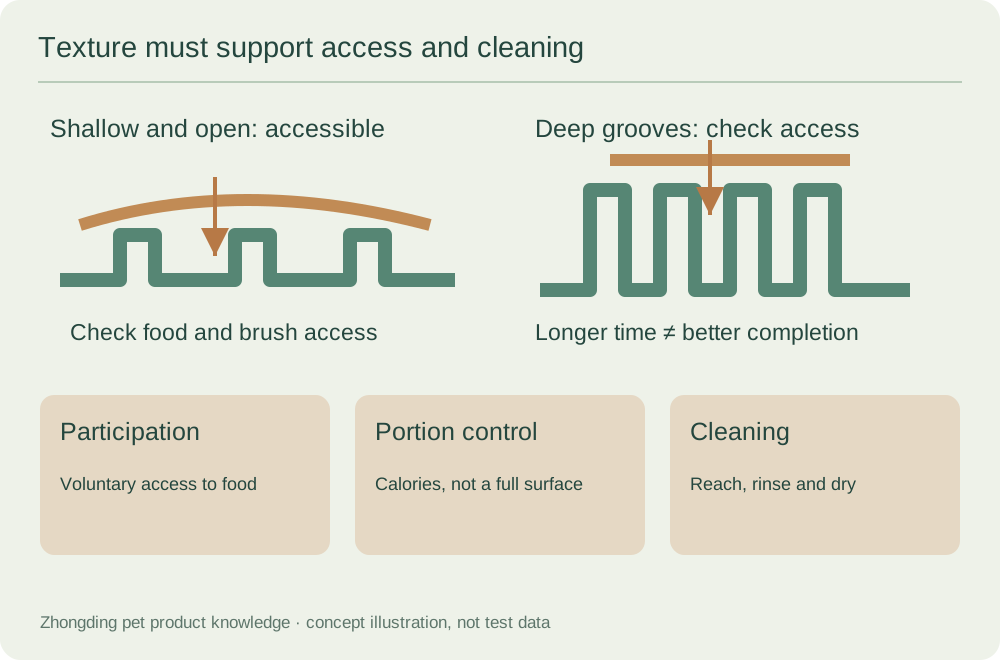
Shallow, open areas can provide an introduction. Local changes in the path can add variety, while deep narrow grooves make both feeding and brushing more difficult. Compare how the same food spreads, remains and rinses away from different regions before covering the entire surface with a complex maze.
Filling is part of the experience too. A surface that curls during spreading, pushes food to the edge or cannot lie open for washing makes maintenance harder. Observe stability during filling, animal use and cleaning separately. Suction features should be evaluated on the actual mounting surface; a dry, flat demonstration does not establish performance on curved, rough or greasy surfaces.
If licking turns into edge chewing, end the session and inspect the item. Persistent gripping is not proof of preference. Supervise both everyday use and sample evaluation, and do not let an animal destroy a product merely to measure how long it lasts.
Manage portions by calories, not by filling the mat
The WSAVA Nutrition Committee’s dog-treat guidance recommends keeping treats to no more than 10% of daily calories and discussing suitable types and quantities with the veterinary team. This is canine nutrition guidance, not a silicone safety standard or an individual feeding prescription. WSAVA: feeding treats to your dog
Design can make a small amount easy to spread, without requiring every groove to be full. Food reserved from the daily complete diet should be included in that day’s allocation. Additional foods contribute additional calories. Veterinary advice is needed for disease, allergy, prescribed diets and life-stage feeding plans.
Consider an arithmetic example only. Suppose a veterinarian has set a dog’s daily energy allocation at 400 kcal: 10% is 40 kcal. If a chosen food is labelled at 2 kcal/g, 40 kcal corresponds to 20 g. Both inputs are hypothetical and are not instructions for feeding a particular pet. The calculation illustrates why equal volumes can contain different calories: millilitres per cavity cannot by themselves determine cavities per day.
Check ingredients when considering human foods. The US FDA warns that xylitol is toxic to dogs and may occur in some nut butters and other products. A sugar-free label does not establish pet suitability. FDA: xylitol is dangerous for dogs
Freezing changes the food, not automatically the benefit
Frozen food differs in hardness, adhesion and feeding behaviour. An animal that licks a room-temperature filling may chew when it becomes hard. Treat-mould development should therefore consider released shape and actual consumption. Excessively hard food, sharp edges or unsuitable dimensions cannot be justified by the material of the mould.
Longer licking time should not automatically become a claim about anxiety relief or disease prevention. Record participation, task completion and handling objectively. Stronger behavioural or health claims need an appropriate study design.
How Zhongding can support development
The Zhongding team has years of silicone product manufacturing experience. Existing mould and container structures support discussions about zones, capacity, release, base stability, edges and cleaning paths. New licking-product projects can begin with accessible samples and a defined food, then develop through observation.
Bring three concrete scenes: filling, food retrieval and cleaning. Comparing the same food and portion under similar conditions can reveal more than broad claims about fun or durability. Zhongding’s customization service can help turn those observations into sample and geometry discussions that support consistent, appropriate use.