
Resistance is not always a hardness problem
Resistance may reflect unfamiliar handling or pain. Cornell’s Feline Health Center advises veterinary consultation before brushing when severe gingivitis may make it painful. Its staged introduction to toothbrushing also recognizes that acceptance develops gradually. Cornell: feline dental disease and brushing introduction
Bleeding gums, marked bad breath, drooling or changed eating behaviour warrant assessment rather than repeated purchases of softer brushes. Once daily care is appropriate, gradually introduce a nearby hand, lip contact and the tool.
Product observation should distinguish an animal moving away when it sees the tool from withdrawing only when the head enters its mouth. Can the person see the contact point? Must they grip forcefully to control the head? These distinctions help identify whether to change the introduction, head size or handle.
Accepting touch and removing plaque are different objectives
AAHA’s 2019 dental guidelines describe brushing as plaque removal rather than removal of established calculus, emphasize daily care and explain that brushing does not eliminate the need for professional assessment and treatment. AAHA 2019: home oral hygiene
Holding a brush in the mouth therefore does not establish adequate cleaning. The person must control its position and bring the cleaning surface to the intended teeth. Chewing an object should not be described as automatically completing toothbrushing.
Zhongding’s oral-brush development direction focuses on adaptation to oral touch and supplementary mechanical cleaning in a daily routine. It can support development of a care habit, but softness cannot establish equivalence to a fine-bristled toothbrush. Removal of existing tartar or treatment of gingivitis should not be inferred from the design.
Design for access, control and the contact action
Cats, small dogs and larger dogs have different access constraints. One head should not simply be labelled universally suitable. An oversized head may interfere with handling; reducing it while leaving a very narrow neck introduces another design issue. Reach, head contour and connection strength need to be considered together.
A long handle can keep fingers away from the brush-head region and aid observation, but it is not bite protection. Excess length, slipperiness or unclear grip position can also reduce control. Finger-mounted designs bring additional questions about rotation, detachment and exposed fingers. Select the form around the animal and care action, not a softness label alone.
Contact features involve trade-offs too. Dense projections can make rinsing difficult. Features that collapse readily may lead a person to press harder to obtain contact. Evaluate deformation under light pressure, control and residue together. These are design questions, not proof of clinical effectiveness for a particular shape or dimension.
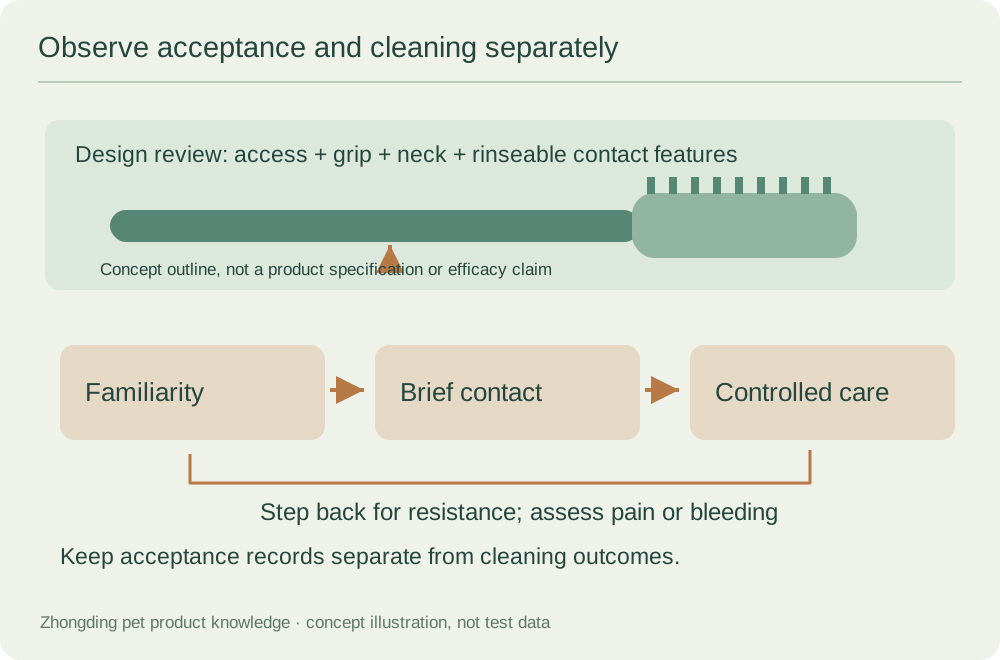
Training and design concept: follow the animal’s response; stop and assess pain, bleeding or marked resistance.
A workable introduction allows a step backwards
After a veterinarian has confirmed that routine care is appropriate, introduce the tool, progress to brief gentle contact and then to controlled tooth-surface care. Limited progress can still be useful. Do not force restraint merely to reach a preset duration. Lower the difficulty or end an attempt when avoidance or tension becomes marked, and seek professional guidance when needed.
Use oral-care products appropriate for the dog or cat rather than human toothpaste. Do not leave the brush as an unsupervised chew object. Inspect its head, projection roots and neck before and after use, stopping for cracks, missing material or connection problems.
For brands, sequential illustrations can explain hand placement, the contact area and when to stop. These help more than an instruction to use daily without showing how. Instructions should also distinguish routine supplementary care from situations requiring a veterinarian.
Evaluate more than a pleasant feel
Begin with structural checks that do not involve animals: grip stability, head control, damage after repeated movement, and access to the roots during cleaning. Then, with appropriate professional guidance and an animal willing to participate, observe the care action itself.
Keep acceptance records separate from cleaning outcomes. Acceptance records can describe approach, contact, withdrawal and handling difficulties. Claims about plaque removal require an appropriate independent evaluation. Reports that users find a tool convenient cannot be converted into a cleaning-effectiveness percentage.
Preserve the reasoning when revising samples. Making everything softer might help introduction without improving control. Thickening a neck may address durability while increasing mouth interference. A useful solution develops the intended contact region and actual action together.
How Zhongding can support development
The Zhongding team has years of silicone product manufacturing experience and has explored long-handled, double-ended silicone oral-brush concepts. New projects can develop head contours, grips, contact layouts, material requirements and sample evaluation. These are development directions; finished configurations and claims need to be established for the project.
Through Zhongding silicone customization, customers can provide the target animal, intended contact area and most difficult action. We can translate these into discussable structures and sampling conditions, improving both how easily care begins and how appropriately the tool is used.