
The useful questions are what the step is intended to achieve, whether the result has been validated, and whether samples and production parts have the same processing history.
Why might treatment be needed after the initial cure?
The initial cure turns the compound into an elastomeric part that retains its shape. Being able to demold it does not automatically establish that all use-related requirements have been met. Dimensions, behavior under compression, odor or volatile-related requirements may involve subsequent processing and inspection.
WACKER's processing guide discusses fresh-air supply, removal of low-molecular-weight volatile constituents and possible peroxide by-products, loading arrangements and avoidance of cross-contamination during post-curing. This makes post-curing a controlled operation, rather than simply a temperature and time entry. Source: WACKER materials and processing guide, post-curing section
Two questions should remain separate: which constituents are removed during treatment, and whether the treated product meets its performance requirements. Recording that post-curing was performed does not answer the second question.
Does platinum-cured silicone also need post-curing?
The term “platinum-cured” alone is insufficient to decide. Consider the curing system, formulation, supply condition and final use together. A material name does not replace a complete production specification.
Materials designed without a post-curing requirement do exist. Elkem's public material information identifies its LSR 8800 series as a non-post-cure option. This establishes a specific material route; it does not mean every LSR grade, color or finished product can omit post-curing. Source: Elkem material information
Ask which grade the project uses, what the supplier recommends for that application and processing condition, and what supports including or omitting the step. “We have always done it this way” does not explain how the process meets the current product requirements.
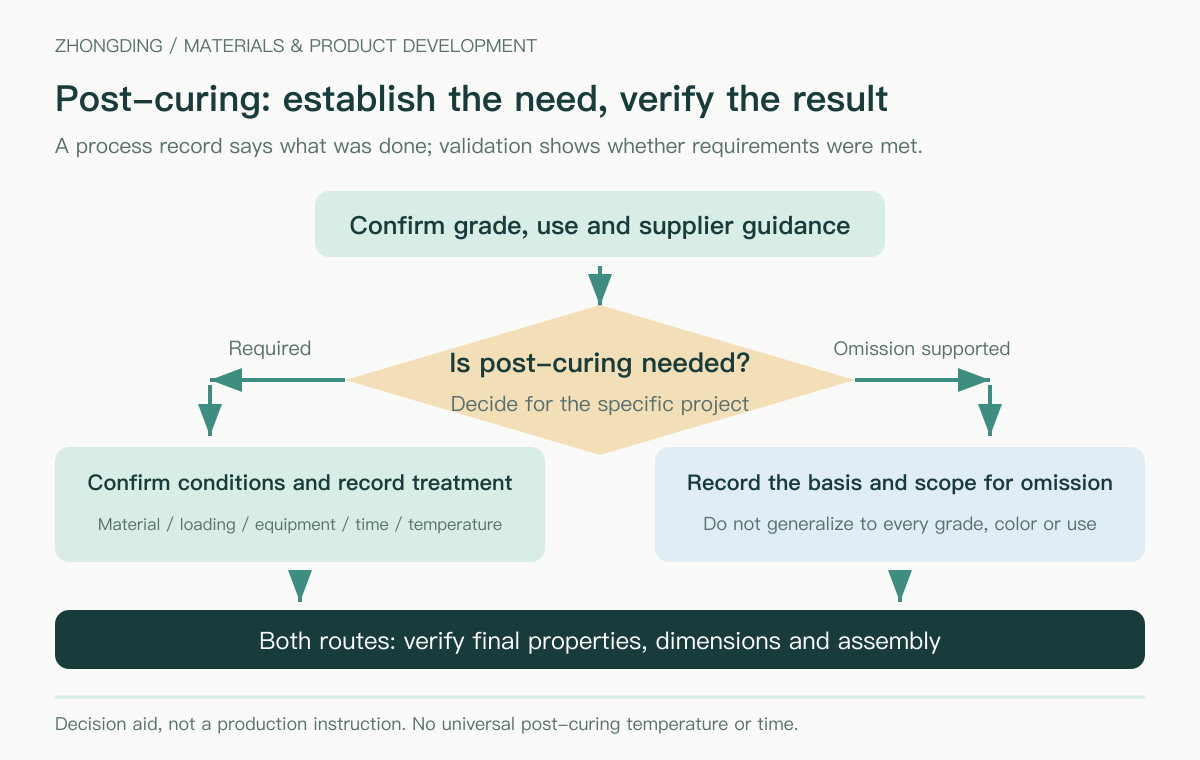
Figure 3. Including or omitting post-curing needs a basis; either route must meet the final product requirements.
Why not copy a temperature and time from the internet?
The same nominal conditions cannot be assumed to produce identical results with different part thicknesses, loading arrangements or equipment. An online example may apply only to a specific grade or test specimen.
A post-curing record should bring the following information together:
| Information | Why it matters |
|---|---|
| Material and color revision | Avoids applying an unverified old conclusion after a material or color change |
| Thickness and geometry | Distinguishes test specimens, thin parts and thick parts |
| Loading and equipment conditions | Gives a reproducible context to the stated time and temperature |
| Treatment objective | Identifies the intended property, volatile-related measure or other requirement |
| Before-and-after assessment | Shows whether the required result was achieved, rather than merely recording an operation |
Buyers do not need to prescribe unvalidated processing parameters. Define the outcome clearly and ask the supplier to explain the process selection using applicable material guidance and sample results.
Can post-curing solve silicone odor problems?
A perceived odor and a measured test result are different kinds of information. A sensory observation describes an experience under particular conditions; an analytical or test result describes a specified measurement method and property.
If odor is a project requirement, define sample condition, packaging, observation timing and acceptance method. A freshly removed hot sample and one stored for some time may not produce comparable feedback. Lack of noticeable odor does not establish that all constituents, migration behavior or contact uses have been validated.
A practical sequence is to record the condition in which the problem appears, review material, production and packaging changes, then decide which factor to investigate. Extending heat treatment without identifying the issue treats every odor problem as insufficient heating, which is not a sound diagnosis.
Post-curing is not a universal repair for molding defects
An incomplete shape caused by a short shot requires a review of molding. Excessive flash calls for investigation of mold and process conditions. Post-curing cannot replace missing geometry and is not a trimming operation.
For incomplete cure or a tacky surface, check material identity, mixing and contamination. YIZUMI includes mixing accuracy, contamination control and cure conditions in its troubleshooting guidance, rather than recommending more heating in every case. Source: YIZUMI cure and surface-defect troubleshooting
If an initial sample has a clear abnormality, record the cause and corrective action. A response that it “feels normal after reheating” is not enough to explain whether later batches will be repeatable. That depends on controlling the cause.
What makes a useful post-curing validation record?
Compare samples made with the same material and production conditions, documenting the initial molded state and candidate post-treatment states. Check dimensions, appearance, assembly and the properties important to the project. Where specialist testing is involved, have a suitably capable laboratory confirm the method and sample conditions.
Consider a hypothetical silicone gasket installed in a fixed gap. Even if post-treatment improves one material property, the treated part's dimensions and actual assembly still need checking. Improvement on a specimen does not necessarily become improvement in the assembled product. This example illustrates a validation approach, not a completed Zhongding test.
Record when measurements are taken after treatment, how samples are stored and how they are measured. Include the agreed production condition in sample approval records, then review the need for revalidation when materials or processes change.
How Zhongding brings post-treatment into the project brief
The Zhongding team brings years of silicone product manufacturing experience to discussions of materials, geometry, tooling and sample behavior.
For custom silicone projects, Zhongding can include post-treatment in discussions of materials, samples and production requirements: whether it belongs in the proposal, how the sample condition is recorded and which functions need final review. Start with the use scenario, material requirements and any observed sample problem; you do not need to prescribe a baking temperature first.
This helps address unclear differences between sample and production conditions and processing requirements missing from approval records. Where volatile, migration or other specialist testing is needed, confirm the applicable method, samples and testing arrangements separately. A record of post-curing cannot replace the test result.
What should be confirmed during inquiry and sample review?
Focus on four questions: whether post-curing is needed and why; whether the proposed supply includes it; whether samples and production use the same processing state; and which results establish acceptance. These are more useful than asking only whether a second heat-treatment step exists.
Organize use conditions, material requirements and sample concerns in a silicone product development brief, then contact Zhongding through the contact page. Post-curing should be confirmed for the project, not advertised as a universal promise detached from the grade and application.