
Heat resistance, insulation and conduction are separate properties
Heat resistance asks whether a material retains the required function in a thermal environment. Insulation concerns slowing heat transfer. Conduction concerns moving heat effectively along a chosen path. A heat-resistant material can still become hot to touch; a thermally conductive material is not automatically suitable for unlimited operating temperatures.
For Zhongding’s existing silicone kitchen products, a trivet calls for attention to temperature rise on the table side and stable support. A silicone-covered cooking spoon has a working end, connection and grip with different tasks. The material name alone does not answer those thermal questions.
Fillers help change the heat-transfer path
Appearance does not reliably distinguish ordinary silicone rubber from a thermal interface compound. Suitable fillers and formulation design alter heat transfer, while the material also needs to accommodate the surfaces it connects. Shin-Etsu describes silicone thermal interface materials as composites containing a high proportion of thermally conductive fillers; some products use alumina. Shin-Etsu thermal interface materials
WACKER’s October 2025 material guide gives a typical silicone rubber thermal conductivity of approximately 0.2–0.3 W/(m·K), specified at 100°C. This indicates an order of magnitude, not a universal value for every formulation or a measured Zhongding product property. WACKER material and processing guide, thermal properties section
Increasing conductivity is only part of the product objective. If a candidate fails to conform to the mating surfaces, or requires excessive pressure to reach its installed thickness, assembly force and the connected parts also need evaluation. The relevant design object is the complete thermal path.
A simple calculation shows why thickness matters
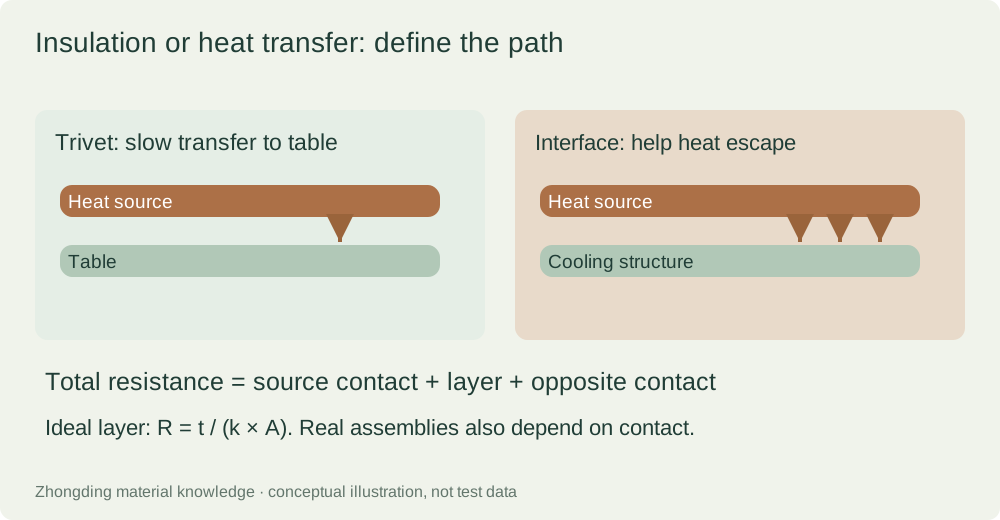
For a uniform layer under ideal one-dimensional steady conduction with planar contact, its thermal resistance is R = t/(k×A), where t is thickness, k is thermal conductivity and A is heat-transfer area. Real products also have interface resistance, lateral heat flow and other heat exchange, so this is not a complete temperature-rise model.
The following assumed values illustrate the relationship. They are not supplier or Zhongding measurements. Assume an area of 10 cm², a uniform layer and perfect contact, neglecting resistance at both interfaces.
| Assumed case | Thickness t | Assumed conductivity k | Calculated layer resistance R |
|---|---|---|---|
| A | 1 mm | 0.25 W/(m·K) | 4 K/W |
| B | 1 mm | 2 W/(m·K) | 0.5 K/W |
| C | 2 mm | 2 W/(m·K) | 1 K/W |
B and C have the same assumed conductivity, but doubling thickness doubles the layer resistance. These calculations neither measure a real product nor determine a safe touch temperature. They demonstrate why a conductivity figure should be considered together with thickness.
Interfaces can change the selection outcome
An assembled path can be approximated as three contributions: the contact between the heat source and material, the material layer, and the contact with the next component. Poor interface contact can dominate even when the layer itself performs well.
ASTM D5470-17(2024) distinguishes thermal impedance from apparent conductivity and describes using different specimen thicknesses to separate contact effects. Its official explanation reinforces the need to understand how a reported value was obtained. ASTM D5470-17(2024) official description
Extend the hypothetical example by adding total interface resistance. If A has 0.2 K/W of interface resistance, its total is 4.2 K/W. If B has poor contact and 5 K/W at the interfaces, its total is 5.5 K/W. B has the higher assumed conductivity but the greater total resistance. All values are illustrative assumptions and cannot select a commercial grade.
When comparing samples, record pressure, installed thickness, surface condition, test temperature and assembly arrangement. Keeping these conditions controlled or documented helps reveal whether an improvement came from the material or from installation changes.
Thermal conduction does not determine electrical conduction
Heat transfer and charge transport are different properties. A thermally conductive material should not automatically be considered electrically conductive. Equally, a silicone base does not establish the electrical insulation performance of a complete formulation.
For appliance applications, specify thermal and electrical requirements separately. If formulation or thickness changes, examine the corresponding electrical requirements again. The purpose is to avoid turning several independent properties into one vague material label.
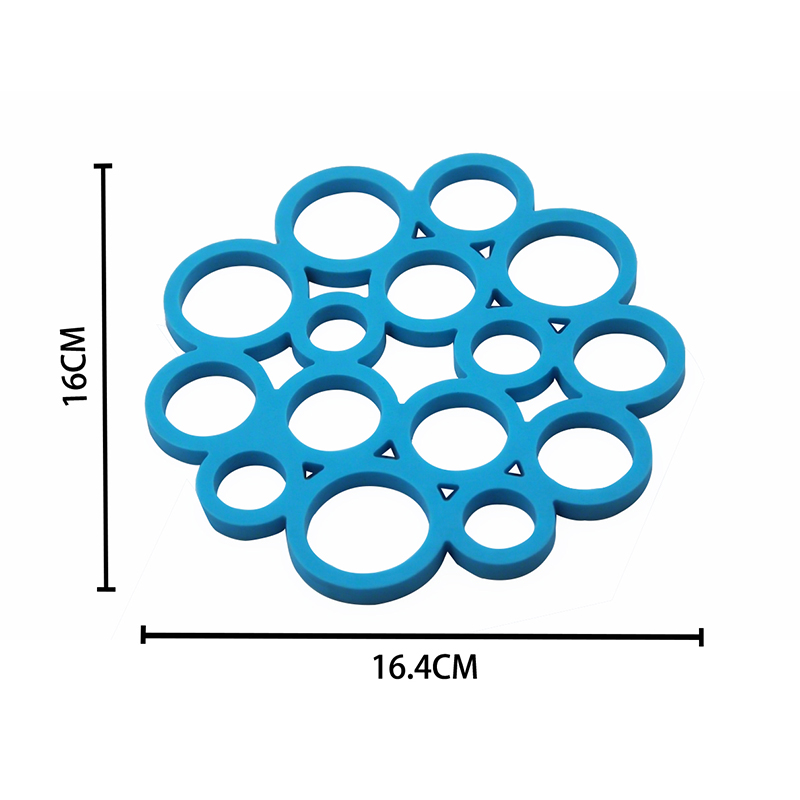
Existing Zhongding openwork silicone trivet: an example for support and heat-path discussion.
Illustrative scenario: making a silicone trivet thinner
This is a hypothetical product discussion, not a completed Zhongding project or a test report.
Suppose a customer wants to reduce the storage bulk of an openwork silicone trivet while continuing to support a hot pan. First define the pan shape and weight, contact temperature and duration, tabletop material and acceptable temperature rise. Then compare thickness and geometry.
Simply substituting a more thermally conductive formulation would generally work against the objective of slowing heat transfer to the table. A higher material number is not automatically a better product.
Compare the original and proposed thinner structures while recording table-side temperature over time, deformation under load and any local direct contact. Openwork changes contact paths but also affects support and heat transfer. Evaluate it with the intended pan and loading conditions rather than assuming more openings are always better.
Zhongding’s team has years of silicone product manufacturing experience. Its existing kitchen products provide starting points for discussing dimensions, shape and user experience. A move into thermal interface applications would require a fresh discussion of materials, processing and verification; a trivet formulation should not simply be reused for a different function.
In a custom silicone product brief, explain whether heat should be slowed or carried away, then describe the geometry and contact conditions. That gives a clearer basis for development than the material name alone.