
Zhongding's existing tapered, flat-profile, ribbed and carry-loop bottles illustrate different handling and packing needs. This article focuses on locating leakage, rather than repeating a complete sourcing guide or a chemical-compatibility assessment.
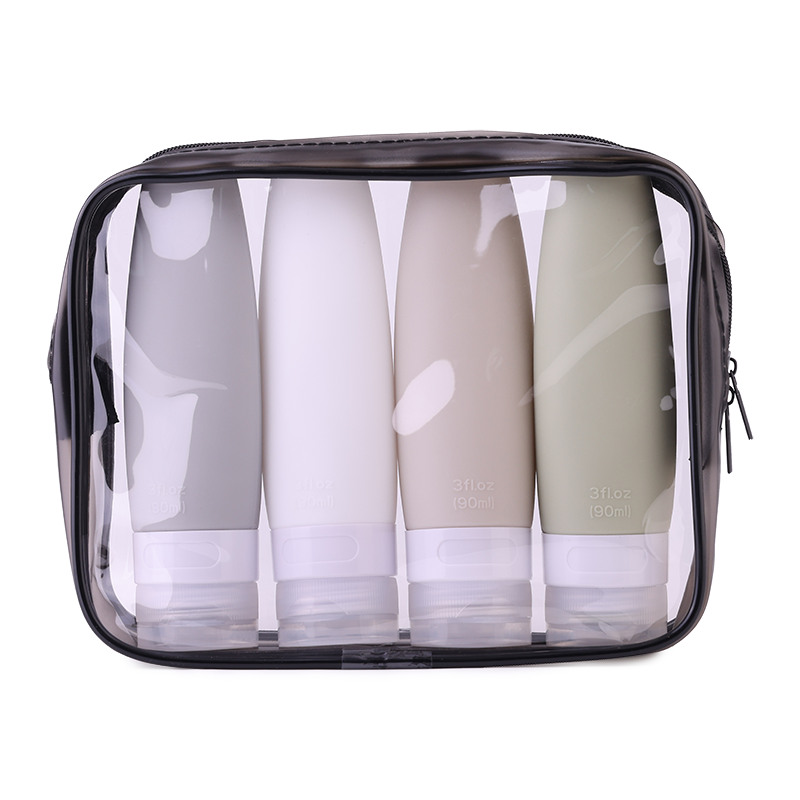
An existing tapered product range. Shape and color arrangements are visible; leak performance requires evaluation with the intended contents and sample conditions.
Separate residue, static leakage and leakage under pressure
External residue can come from filling, dispensing or liquid returning toward the opening. Static leakage continues without deliberate squeezing. Pressure-related leakage may appear only when a bottle is gripped, packed tightly or compressed by luggage. These conditions can overlap, and a photograph taken afterward rarely distinguishes them.
Clean and dry the exterior and closure area, record the starting condition, and observe the assembled bottle in the specified orientation. Follow the first wet point. Dismantling every part at the outset can destroy useful evidence about the original path.
| First wet location or condition | What to investigate | Common mistaken conclusion |
|---|---|---|
| Neck or body-to-cap interface | Seating, contamination at contact surfaces and local deformation | The liquid must be passing through the silicone |
| Closed outlet | Closure engagement, actual outlet mechanism and residual liquid | A covered outlet must be sealed |
| Local exterior residue that does not return after wiping | Filling or dispensing contamination | Every wet mark is continuing leakage |
| Leakage only after packing | Pressure location, orientation, fill and packaging restraint | Upright storage alone is an adequate check |
These are diagnostic directions, not conclusions about a particular sample.
The cap, neck interface and outlet have different jobs
A flip cap covers an outlet, but its sealing role depends on the actual internal design. Some designs rely on a plug contact; others include a separate dispensing component. A flip-cap shape alone does not establish a leak-control valve. Threads help assemble and clamp components; the actual sealing contact still needs to be identified.
Squeezing changes the available internal space and drives liquid toward an available flow path. The outlet must allow intended dispensing while controlling unwanted flow when closed or packed. Making it harder to open can increase effort or produce sudden dispensing. Making the body softer can make it easier to compress during storage.
Assessment should therefore continue after the squeeze ends. How does the body recover? Does liquid remain at the opening? Does closing the cap move residue onto the outside? Following the whole action can reveal problems that isolated dimensional checks miss.
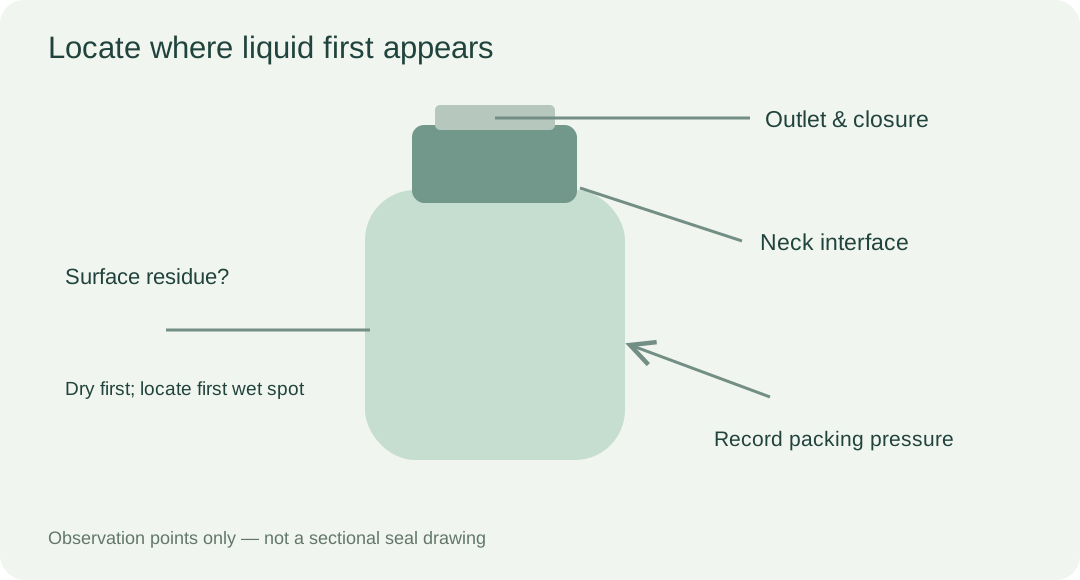
Inspection concept only; this is not a sectional drawing of the featured product's seal.
Record fill and environmental conditions
Trapped air volume, temperature and external pressure affect pressure differences. OpenStax's University Physics Volume 2 explains the ideal-gas relationship pV = nRT, with absolute pressure and absolute temperature. It helps identify related variables. A flexible bottle is not a fixed-volume rigid vessel, however, so the equation cannot directly predict its leakage. Original textbook: Molecular Model of an Ideal Gas
For sample comparison, make fill, closure and environmental conditions repeatable. Do not assign an unverified universal headspace percentage. Shampoo, lotion and low-viscosity liquids can dispense and leave residue differently. A water check does not establish suitability for every formulation. Compatibility with the body and other wetted components is a separate question.
Make the comparison diagnostic
Fix the liquid, assembly method and observation period before changing one factor. Compare upright and inverted conditions first, for example, then introduce a defined compression condition. If the liquid, fill, cap and packaging all change together, an improved result will not reveal which change mattered.
Record sample identification, formulation, fill, orientation, temperature conditions, loading method, first wet location and photographs. If mass loss is measured, agree on the weighing method and instrument resolution. Distinguish actual leakage from exterior residue and other possible influences. Duration, applied pressure and acceptance criteria should follow the project use case; a self-defined check is not an industry-wide standard.
For ordinary toiletry liquids carried through U.S. TSA checkpoints, the FAA's PackSafe page identifies a 100 mL (3.4 fl oz) container restriction. This concerns that screening situation. It is neither leak certification nor a universal rule for every route. Check the relevant airport and screening requirements before travel. FAA: Medicinal & Toiletry Articles
Connect the problem to a product decision
The flat-profile, carry-loop and ribbed formats in Zhongding's silicone travel bottle range support different handling and packing discussions. For custom silicone travel bottles, we can start with an existing format and review structural options, colors, branding and sample requirements against the intended contents, capacity, dispensing action and packaging.
Our team has years of silicone product manufacturing experience. Identifying where leakage begins and whether it occurs during use or storage gives the assessment a practical focus. Reproducible conditions and the actual contents help avoid repeated sample changes without a clear diagnosis.
Use the travel bottle sourcing guide for the broader selection process. Any leak-resistance claim should ultimately match the particular sample, contents and evaluation conditions, so the instructions reflect the product's demonstrated behavior.