
Why the material can recover its shape
The silicone elastomer used for a cup body is different from the granular silica gel found in desiccant sachets. GB 4806.16—2025 defines food-contact silicone rubber in terms of an organic silicone elastomer formed through crosslinking and curing of materials including polysiloxane polymers and hydrophobic silica. GB 4806.16—2025, Section 2
A useful way to understand the cured material is as a connected network. Within suitable limits it deforms under force and can recover when that force is removed. This creates design opportunities for the feel of a rim, local compression and certain assembly features. But deformation also means that squeezing a filled cup can change its rim shape and internal volume. Comfort and reliable function therefore need to be considered together.
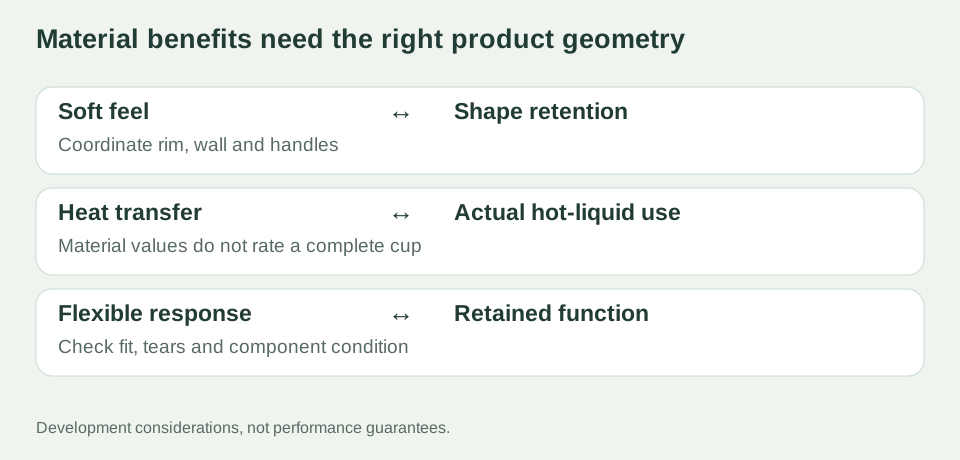
One hardness value cannot answer every design question. Thick and thin walls made from the same material feel different. At the same thickness, flat walls, curved surfaces and local reinforcement respond differently. A better starting point is to identify where flexibility is useful and where shape retention matters, then evaluate samples instead of making the entire cup uniformly softer.
What a conditional material value can tell us
On page 87 of its October 2025 Solid and Liquid Silicone Rubber: Material and Processing Guidelines, raw-material producer WACKER gives a typical thermal conductivity of approximately 0.2–0.3 W/(m·K) at 100°C, noting the influence of filler type and loading. This is a material reference value. It is not a measurement of a Zhongding cup or a guarantee that all finished silicone products behave identically. WACKER original technical guide, October 2025
Thermal conductivity describes heat transfer through a material. Whether a cup feels hot also depends on wall thickness, drink temperature, elapsed time, handle geometry and where the user holds it. Lower conductivity can give designers room to manage heat transfer to a grip area. It does not cool the drink to a safe temperature or prevent hot liquid from spilling.
For the same reason, grip insulation and drink-temperature retention are separate questions. A relatively slow rise in outer-wall temperature does not state how long a beverage stays warm. Heat loss through the opening, lid design, surroundings and fill quantity all matter. Without complete-cup testing, claims such as a particular number of hours of heat retention or “never hot to touch” are unsupported.
Three cup formats offer different starting points
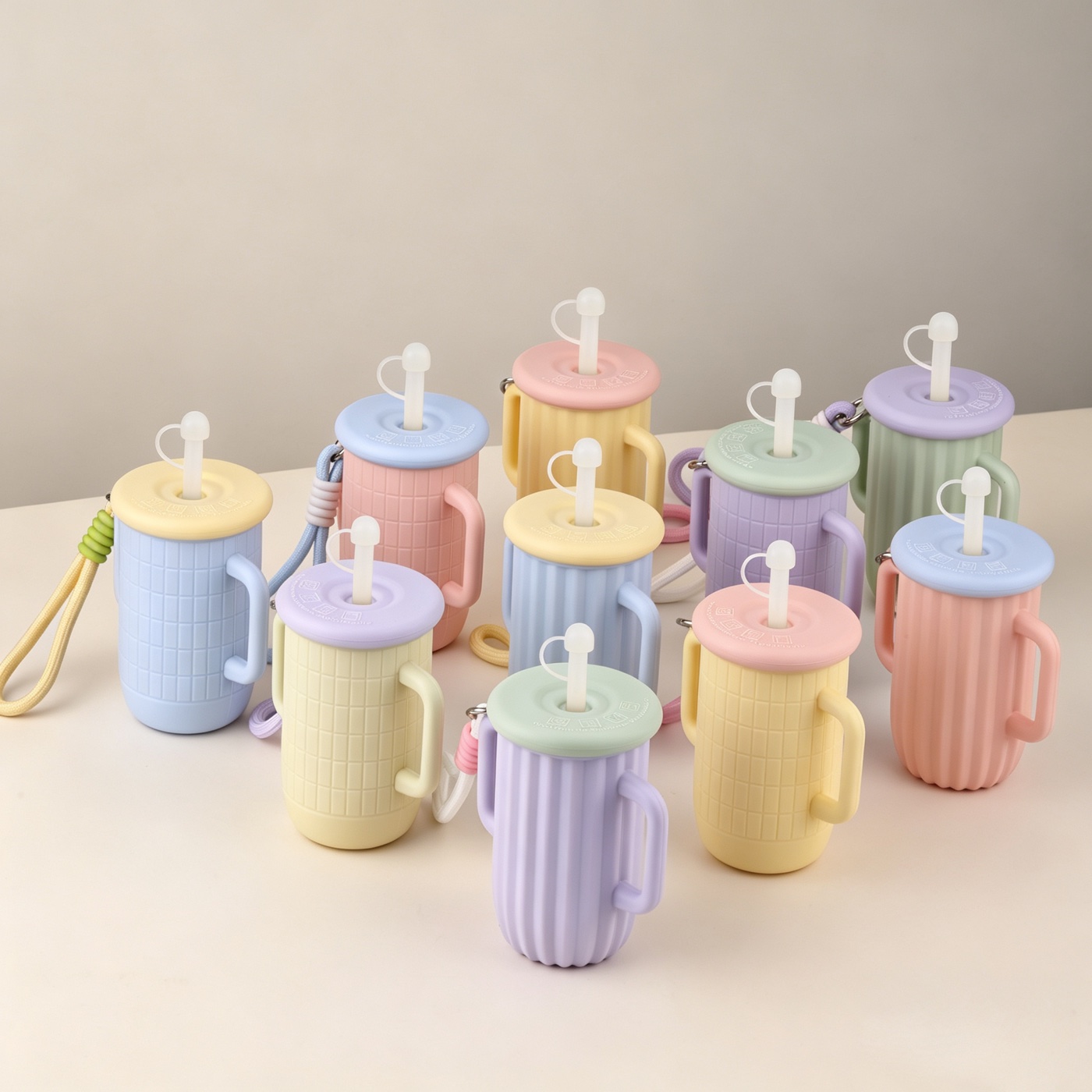
Zhongding’s single-handle silicone straw cup places its handle on one side and combines a lid, straw and carry cord. It is a useful starting point for discussing one-sided lifting and accessory configuration. Development questions include where the user grips, how the cup is lifted and whether ordinary handling unnecessarily compresses the body.
The ribbed double-handle silicone cup offers grip positions on both sides. The column-textured double-handle cup uses a different body texture and profile. These differences can create a recognisable range while allowing a brand to compare grip clearance, storage space and cleaning access. Whether a particular texture improves grip requires assessment of its shape, surface condition and hand contact. Texture alone does not justify a promise of slip-free use with wet hands.
| Desired benefit | Material or design opportunity | Design consideration |
|---|---|---|
| A softer contact feel | Elastomer selection and rounded geometry | The rim still needs appropriate shape retention |
| Some local deformation | Flexible fits or local clearance | Not every silicone cup is a collapsible cup |
| Slower heat transfer at the grip | Coordinated handle and wall design | Finished-product hot-liquid use needs validation |
| A coordinated product range | Single handles, double handles, ribs and colours | Material control must include colour and process changes |
Flexibility does not mean indestructibility
A flexible cup body responds to impact differently from a hard, brittle body, creating possibilities for absorbing impact through deformation. However, a complete cup also contains a lid, straw connections and handle roots. A dropped cup may avoid shattering yet still suffer a loose component, local tearing or permanent distortion. Those are failures too.
For custom silicone cups, the useful questions concern function after an event: can the components still be assembled correctly, has the rim changed shape, and is the handle root intact? Any test should define fill state, impact direction and inspection criteria. An untested drop height should not become a product capability claim.
Repeated use is also a design objective, not proof of an unlimited service life or lower carbon emissions. Its practical value depends on cleaning effort, continued accessory fit and retained function. Without a life-cycle assessment, a percentage carbon-saving claim would be unjustified.
Make the material choice support a daily action
China’s State Administration for Market Regulation reminded consumers in February 2026 to check the actual use conditions of plastic and silicone tableware, including microwave and boiling suitability. Material characteristics ultimately need to become accurate instructions for the finished article. SAMR: consumer advice on food-contact products
Zhongding’s team has years of silicone product manufacturing experience. We can discuss appearance, walls, handles and accessories around our existing silicone cup styles. A useful development question is: which user action should become easier or more comfortable, and which areas must remain stable? Answering that question turns a material property into a benefit users can actually experience.